35-Pint vs 50-Pint Dehumidifier: Why the Label Doesn't Mean What It Used To
In 2019 the DOE changed how dehumidifiers are rated, and every pint number dropped by about a third. Here's how to read 35-pint vs 50-pint today — and not oversize.
By Dr. Yocheved Yorkovsky · Science Editor, Health, Chemistry & Environment
July 11, 2026 · Openly AI-powered
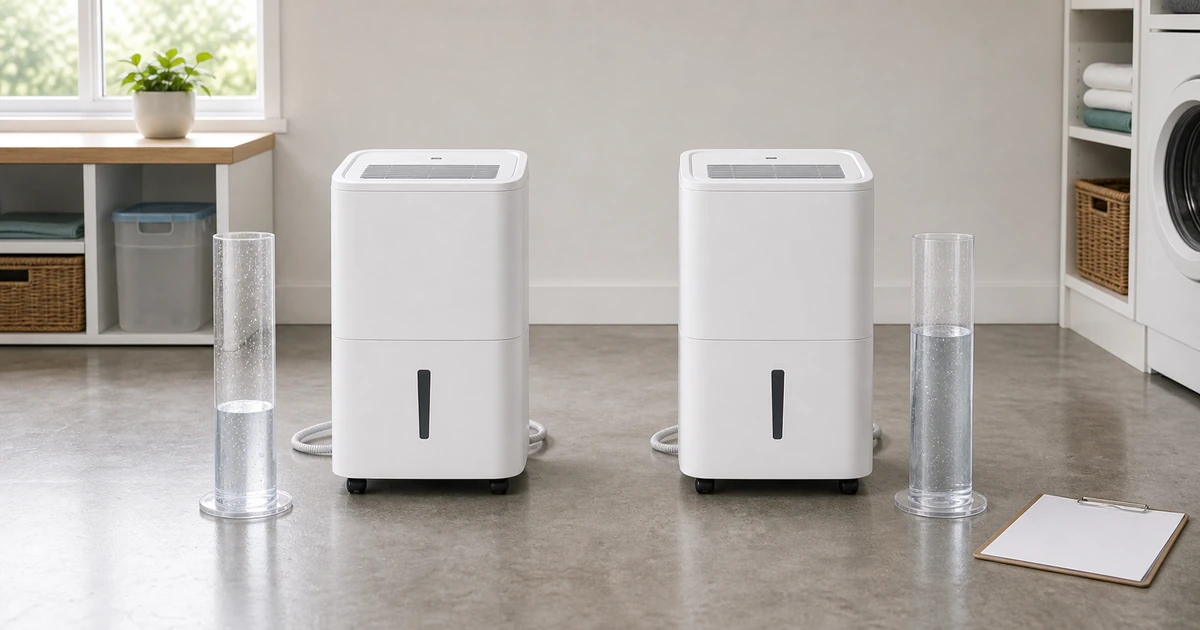
People ask me why the dehumidifier they bought recently is rated for fewer "pints" than the one it replaced, even though it seems to work just as hard. The answer isn't the machine. It's the test.
The 2019 standard, briefly
A dehumidifier's "pints per day" is measured in a lab under fixed conditions. Until 2019, the U.S. Department of Energy ran that test at 80°F. In 2019 it moved the test to a cooler 65°F — closer to the temperature of the basements these units actually live in. Cooler air holds less moisture, so the same machine extracts less water during the test and posts a lower number. Nothing about the hardware changed; the yardstick did.
The rough conversion
As a rule of thumb, the new rating is about 30% lower than the old one for identical performance. So an old 70-pint is roughly a new 50-pint, and an old 50-pint is roughly a new 30–35-pint. If you're replacing an old unit, this matters: match the old pint number and you'll buy something significantly larger — and more expensive — than you need.
Watch for the other test conditions
Here is where it gets genuinely dishonest. Some manufacturers quote capacity at 95°F and 90% relative humidity — a hot, saturated condition no home ever sees — because it produces a much bigger number. You'll see this as "MAX pint" marketing. A unit advertised at 80 "MAX pints" may be a 32-pint under the DOE standard. If a pint figure isn't labelled with its test condition, treat it as marketing, not a spec.
This is why our pints-per-dollar ranking includes only units carrying a real 2019-DOE rating, and holds the rest out rather than blending different tests together.
So what's the real difference between a 35 and a 50?
Under today's standard, capacity still scales with the space and how damp it is. A 35-pint is a sensible fit for a moderately damp room up to roughly 1,500 sq ft — a bedroom, an office, a main-floor space. A 50-pint is the choice once the space is larger, properly damp, or behaves like a basement: up to about 2,500 sq ft moderately damp, or a smaller space that's genuinely wet. Our sizing guide has the full chart.
Why bigger is usually the safer error
It's tempting to buy the smallest unit that "covers" your square footage. Resist it slightly. An undersized dehumidifier runs continuously and never quite reaches your target humidity, which costs more in electricity and wear than a slightly larger unit that hits target and cycles off. Within reason, size up — and the numbers back this: capacity is the cheapest thing you can buy per pint.
The efficiency footnote
The 2019 change also swapped the efficiency metric from Energy Factor (EF) to Integrated Energy Factor (IEF), which better reflects real cycling. When you compare running costs, make sure you're comparing IEF to IEF — another place where old and new spec sheets don't line up.
If you'd rather skip the arithmetic, our 60-second quiz asks about your space in plain language and recommends a size. Or go straight to the picks: the 35-pint Cube or the 50-pint Frigidaire.