Desiccant vs Compressor Dehumidifiers: Which One Your Room Actually Needs
Two completely different technologies, and the room's temperature decides between them. Here's how each works, and when a desiccant beats a compressor.
By Dr. Yocheved Yorkovsky · Science Editor, Health, Chemistry & Environment
July 11, 2026 · Openly AI-powered
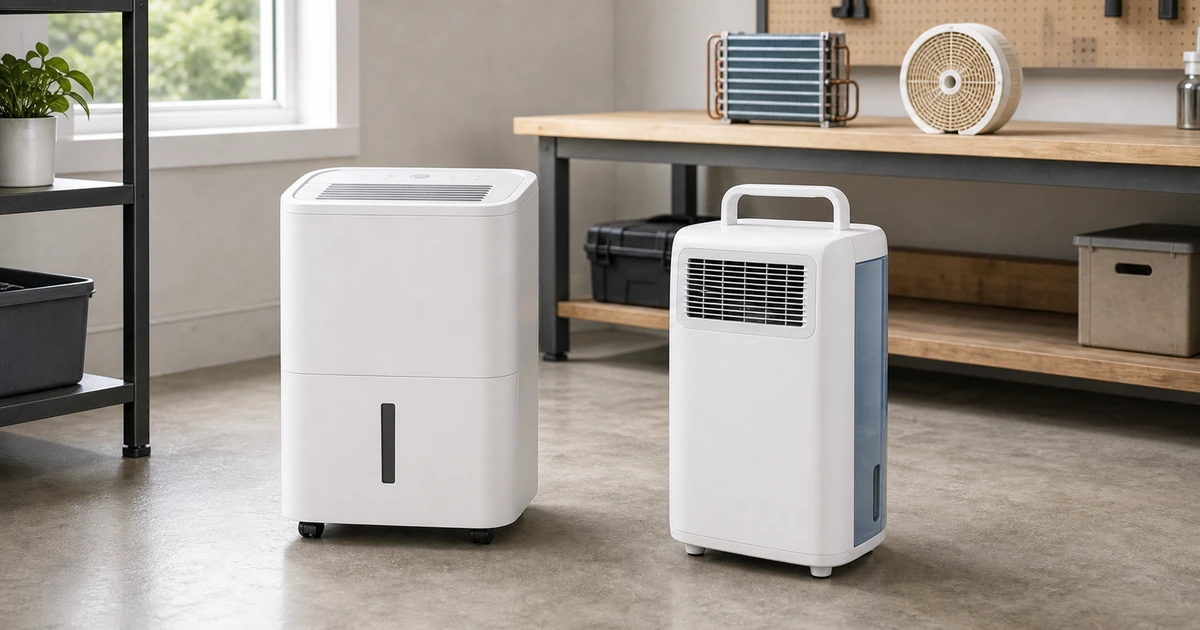
Most dehumidifiers you'll see are compressors. A minority are desiccants. They solve the same problem — too much water in the air — by opposite physical routes, and the right choice depends almost entirely on one thing: how cold the room gets.
How a compressor dehumidifier works
A compressor unit is a small refrigerator that never makes anything cold on purpose. It pumps refrigerant to chill a coil below the air's dew point; moisture condenses on that cold coil, drips into a tank, and the now-dry air is blown back out, slightly warmed. It's efficient and effective — in a warm room. The weakness is built into the method: as the room cools, the coil runs colder still and frost forms on it. The unit then has to pause and defrost, and below roughly 40°F it spends more time defrosting than drying.
How a desiccant dehumidifier works
A desiccant unit has no cold coil and no compressor. Instead, air passes over a slowly rotating wheel coated with a moisture-absorbing material — the same family of chemistry as the silica-gel packets in a shoebox. A gentle heater then drives the collected moisture off the wheel into a separate stream that's condensed and drained. Because nothing needs to be chilled below freezing, a desiccant keeps working in cold air, right down to around 33°F.
The size of that advantage is easy to underestimate. Ivation rates its desiccant at 11.8 pints a day at 41°F — against roughly 2.9 pints for a comparable compressor at the same temperature. That's not a marginal edge; it's the difference between a machine that works and one that doesn't.
The trade-offs
Neither is simply "better." Desiccants have three advantages: they work in the cold, they're near-silent (no compressor to cycle), and they're lighter. They have two costs: they draw more electricity for the same water removed, and they warm the room a few degrees — welcome in a cold garage, unwanted in summer.
So which should you buy?
The decision is short. For a warm room — a living space, a summer basement, a laundry room — buy a compressor. It's cheaper to buy, cheaper to run, and pulls far more water per hour; the Frigidaire FHDD5034 is our default. For a cold room — an unheated garage, a crawl space, a winter cabin — buy a desiccant. A compressor there will frost up and quit; the Ivation IVADDH06 keeps going, and we put the two head to head. And if you need true silence, a desiccant has no compressor to cycle on and off — if you can accept the running cost.
A note on thermo-electric "minis"
You'll also see tiny Peltier units marketed alongside these. They're a third technology, and a much weaker one — fine for a closet, useless for a room, and, like compressors, they fade in the cold. Don't confuse a $45 mini with a real desiccant.
Not sure how cold your space really gets? The quiz asks, and steers you to the right technology.