← All guides
The buyer's guide
Air Conditioners
The BTU number on the box isn't the number that matters. We rank ACs by real cooling power, noise, and fit.
The buyer's guide
The BTU number on the box isn't the number that matters. We rank ACs by real cooling power, noise, and fit.
Real cooling capacity for the room size — SACC where it applies, verified room coverage, and how fast independent tests found each unit pulls temperature down.
Measured and rated noise, and whether an inverter compressor holds a steady hum or cycles on with a clunk. The difference between sleeping through a heat wave and not.
CEER, Energy Star status, and inverter behavior — what a summer of runtime actually costs, not just the sticker price.
Weight, window compatibility, bracket requirements, and how much of a two-person wrestling match the install is.
App quality, voice control, scheduling, and energy reporting — and whether any of it works reliably.
Cooling delivered per dollar, including running costs — a cheap unit that can't cool its room is the most expensive kind.
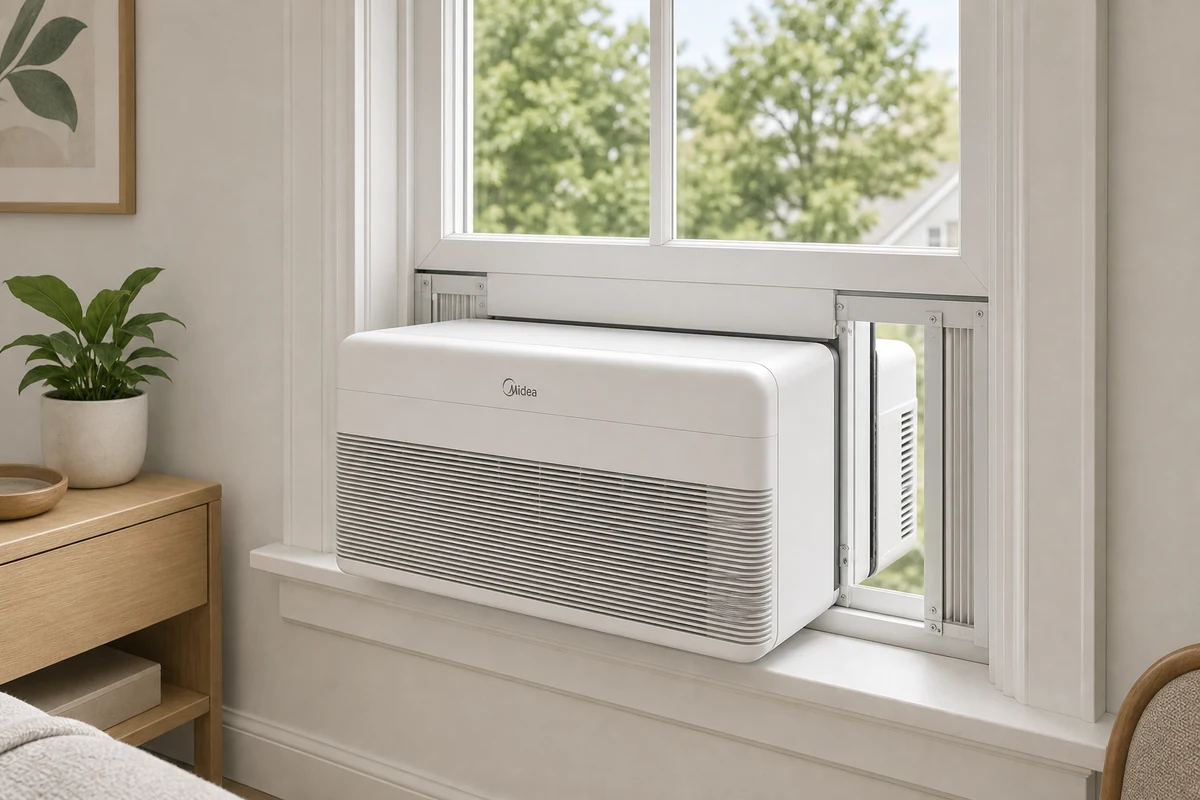
Still the window AC everything else gets measured against.
The U-shape is the whole trick: the compressor hangs outside and your closed window sash becomes a sound barrier between you and it. That's how the U+ runs down near white-noise levels while a conventional unit rattles the frame — TechGearLab measured the U-shaped Midea as the quietest window unit in its entire test lineup — and it's why you can leave it installed and still open the window on a cool night, which no drop-in unit allows. The inverter compressor is the second half of the case. Instead of slamming on and off, it ramps continuously, holding temperature within a degree while sipping power — Midea claims over 35% savings versus the federal standard, and the U series has worn Energy Star's Most Efficient badge for years. Wirecutter has kept this design as its long-running top window AC pick, and NBC Select's reviewers literally bought multiples for their own apartments. The honest history: in June 2025, Midea recalled 1.7 million U and U+ units after water pooling led to mold reports. The current U+ ships with the redesigned drain system that fixes it — but that's an argument for buying new at retail, not a used original off Facebook Marketplace. And budget a real hour for the install: the support bracket and window fitting are more particular than a standard unit's lift-and-drop.
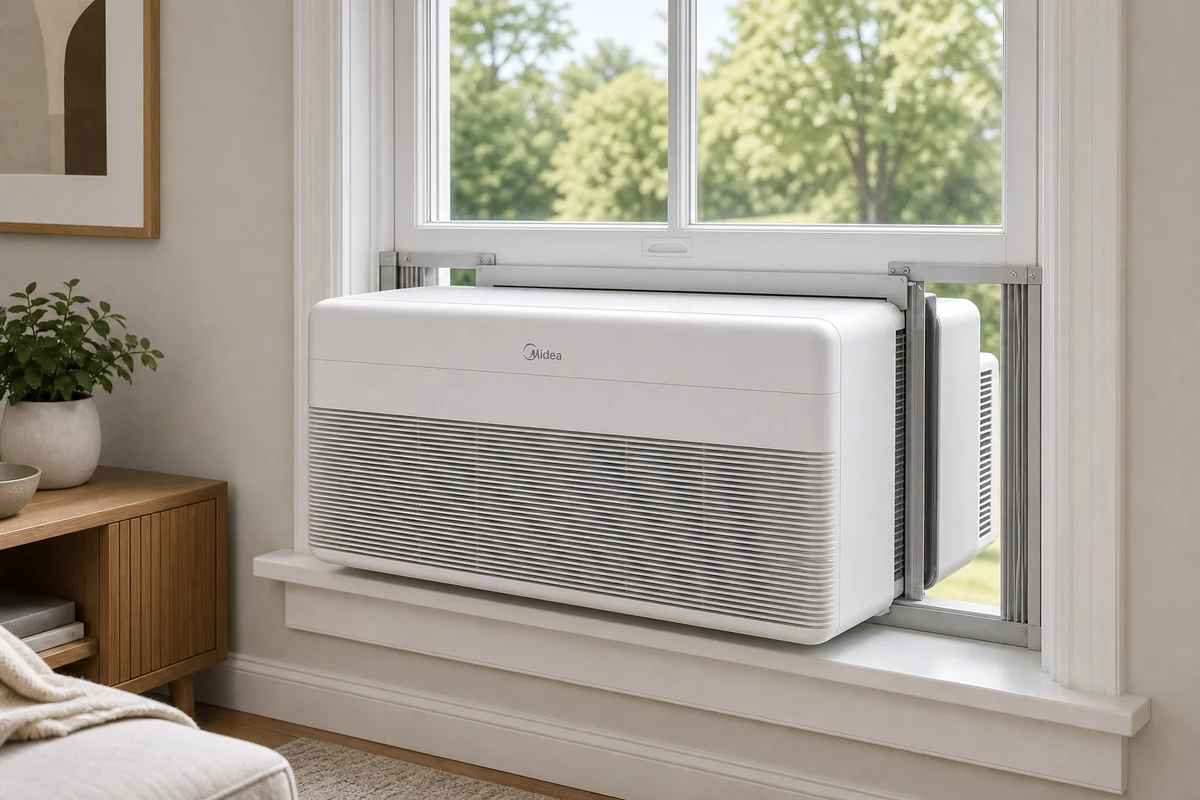
The same near-silent U design, sized for the living room instead of the bedroom.
Most 12,000 BTU window units announce themselves. This one doesn't, because the U design hangs the compressor outside the closed sash — TechGearLab's testers found the 12K U-shaped Midea outscored nearly every unit they tested on noise while still dropping their test room over 12 degrees in an hour. That combination — large-room output with bedroom manners — is what you're paying for over a conventional 12K box. The inverter matters even more at this size. A fixed-speed 12,000 BTU compressor cycling on and off in an open living space is both loud and wasteful; the U+ ramps smoothly and holds the room, and Midea rates the design at up to 45% better efficiency than the federal minimum. Wi-Fi, Alexa and Google control carry over from the 8K. Same caveats as its smaller sibling, amplified: at 59 pounds the install is unambiguously a two-person job with a bracket step some window trims fight (Midea's support arms don't clear every ornate exterior sill — measure first). And the 2025 recall applies to this size too, so buy current stock with the redesigned drain plug, not a garage-sale original.
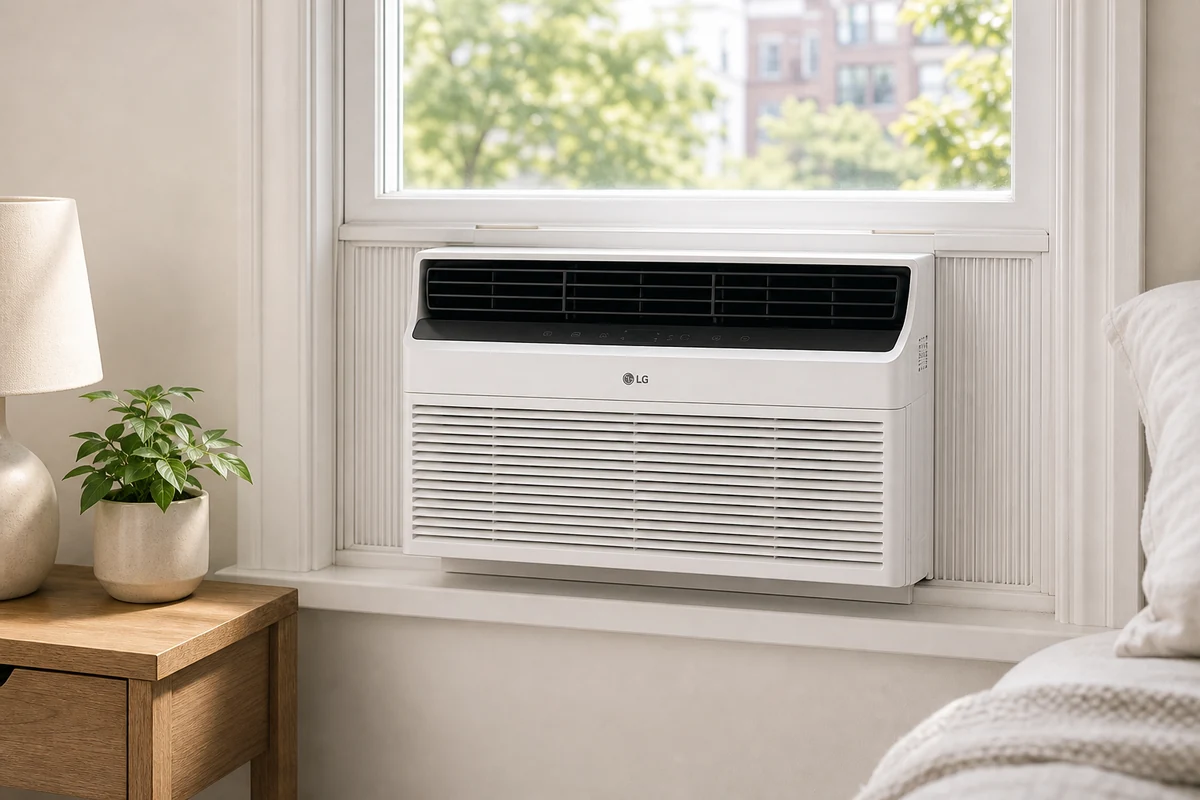
Inverter quiet without the U-shape's install gymnastics.
LG's answer to the quiet-AC question is brute engineering instead of clever geometry: a dual-rotor inverter compressor that ramps smoothly down to 44 dB in sleep mode — library-quiet — while pushing 8,500 BTU across rooms up to 380 sq ft. Owners consistently describe the same experience: it cools fast, then fades into the background instead of cycling on with a clunk at 3 a.m. Because it's a conventional chassis, installation is the familiar lift, set, extend-the-curtains routine — no saddle bracket, no window-frame clearance puzzle, and it fits standard 22–36 inch openings. Four-way air deflection is a quiet advantage over the Midea's two-way vents if your bed or desk sits off-axis from the window. The weak spot is software. LG ThinQ handles on/off, temperature, scheduling and energy monitoring, and it talks to Alexa and Google — but its app-store reputation is genuinely mixed, and this is not the ecosystem to buy for the app alone. Buy it for the compressor.
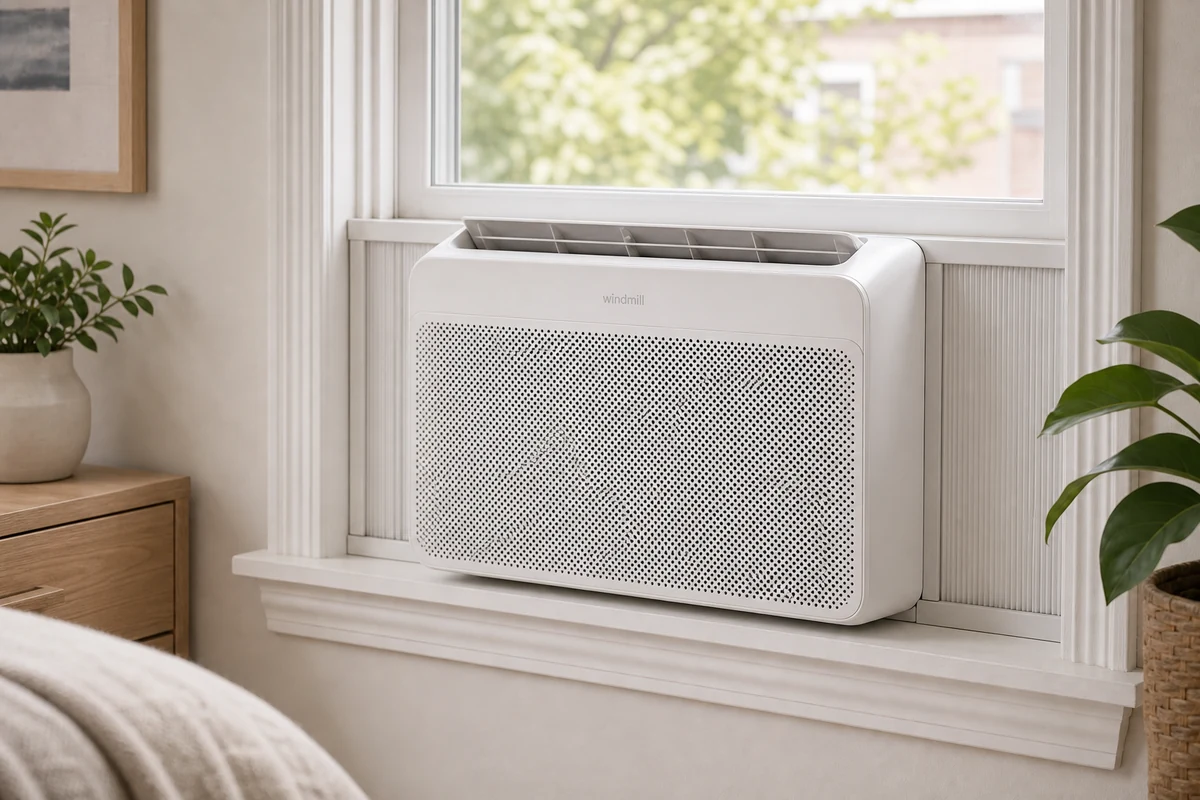
The one window AC that improves the room it sits in.
Every other unit here is an appliance; the Windmill is the one designed like furniture — a flat matte panel, curved edges, auto-dimming display, even swappable colored grilles. In a studio where the AC is permanently in your eyeline, that's not vanity, it's the reason this brand exists. It backs the looks up where it counts for apartments. The install kit arrives pre-assembled — CNN Underscored's testers were done in under 30 minutes across multiple units and multiple years — and the WhisperTech inverter runs from 42 dB with double-insulated side panels that block street noise better than the accordion flaps everyone else ships. The Windmill app is the best-rated in the category, and Alexa and Google control work out of the box. Cooling itself is honest 8,000 BTU work for up to 350 sq ft, with one asterisk: independent testing found it pulls a hot room down a bit slower than the Midea and LG inverters, though it holds temperature just as well once there. At $429 you're paying roughly a $60–80 design-and-experience premium over the Midea U+. Whether that's worth it depends entirely on how often you look at your window.
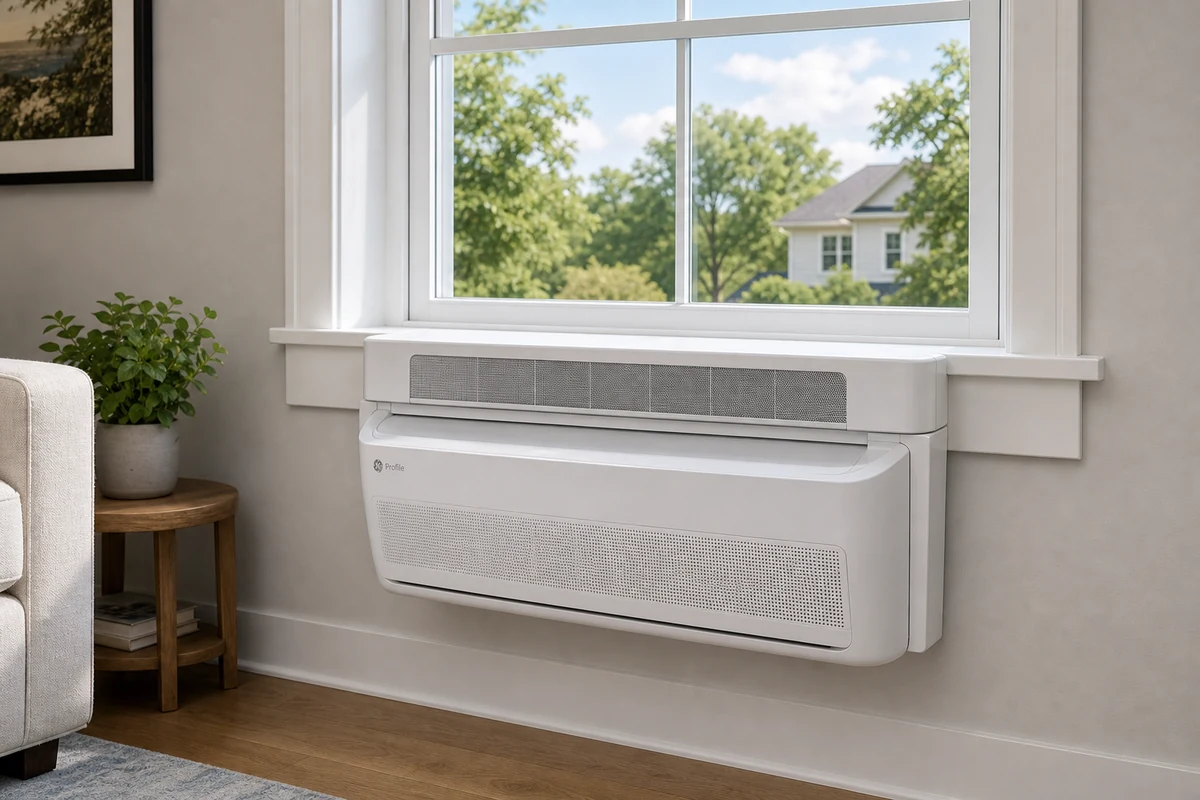
The AC that gives you your window back — view, light, and all.
Flip the Midea U upside down and you get GE's idea: an 'n'-shaped unit that sits mostly below the window sash, leaving the glass — and your view, and your natural light — almost untouched. In a small apartment where the window is the room's only light source, that's not a gimmick; it's the difference between a bright room and a dim one for four months a year. It's a serious appliance underneath. 8,300 BTU covers rooms to 350 sq ft, GE quotes operation down to 41 dB — the brand markets itself as the quietest window-AC maker in the US — and a built-in pump moves condensation out automatically instead of relying on gravity and hope. SmartHQ is one of the better appliance apps, with energy reporting and geofencing that shuts the unit down when you leave. The constraints are physical. The flex-depth chassis fits walls 4.5 to 13.75 inches thick and nothing outside that; Tom's Guide needed three attempts (and two people, and some sill paint) to seat their ClearView correctly; and furniture or radiators under the window can rule it out entirely. Measure twice — this is the least forgiving install in our lineup, in exchange for the best view.
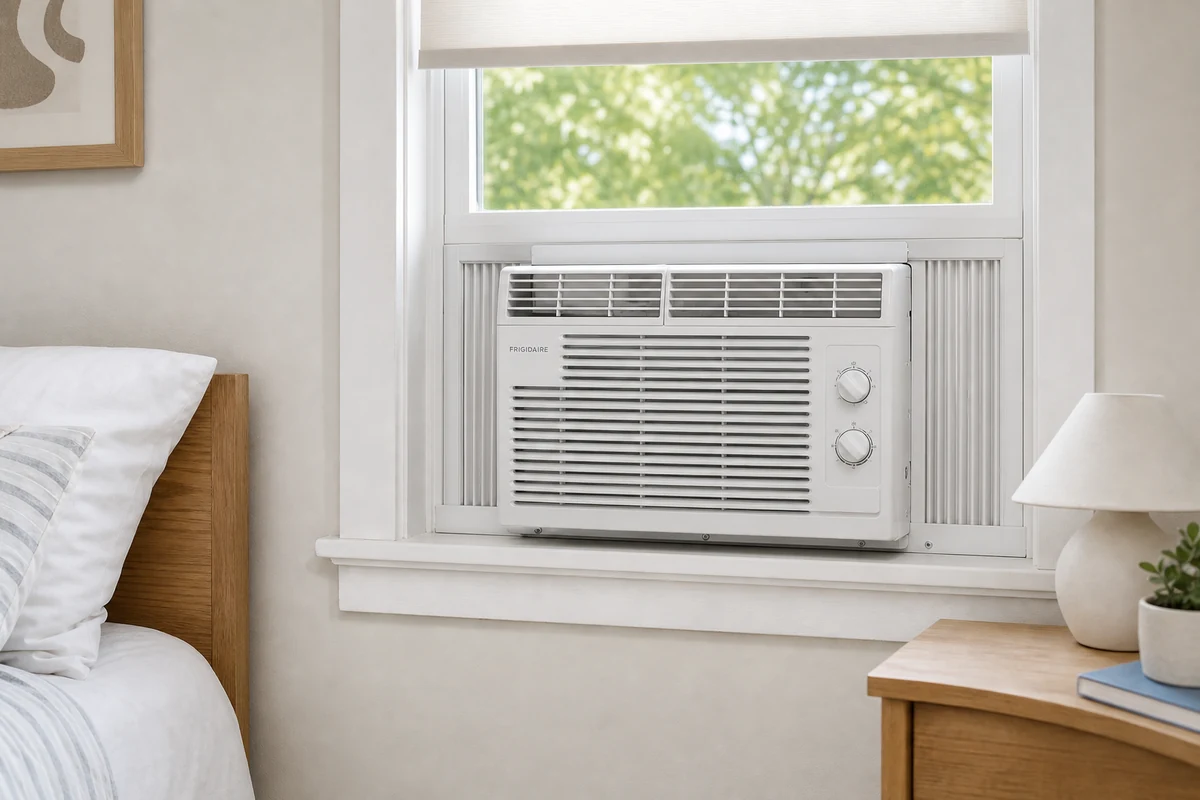
Two knobs, $169, and a cold small room — the honest floor of the category.
There's a reason this exact design has survived a decade of smart-AC launches: it does one job, cheaply, forever. 5,000 BTU is honestly rated for about 150 sq ft — a bedroom, a dorm, a home office — and at roughly 41 pounds it's the rare window unit one person can carry upstairs and seat without drama. The washable filter slides out, the side panels stretch to fit, the extra-long cord reaches the outlet without an extension, and the mechanical-style controls will outlive every app on this page. What $169 doesn't buy is refinement. The fixed-speed compressor cycles on and off at 52 dBA — white noise to some sleepers, an irritant to others — there's no remote, no timer display, no Wi-Fi, and the 'Effortless Temperature Control' is a fairly loose thermostat, not a precision hold. Put it in a room bigger than 150 sq ft and it will run flat out all day and lose. The math is the argument: you could buy one of these for the bedroom and a second for the office for less than a single Windmill. If the room is small and your standards are 'cold and cheap,' stop here.
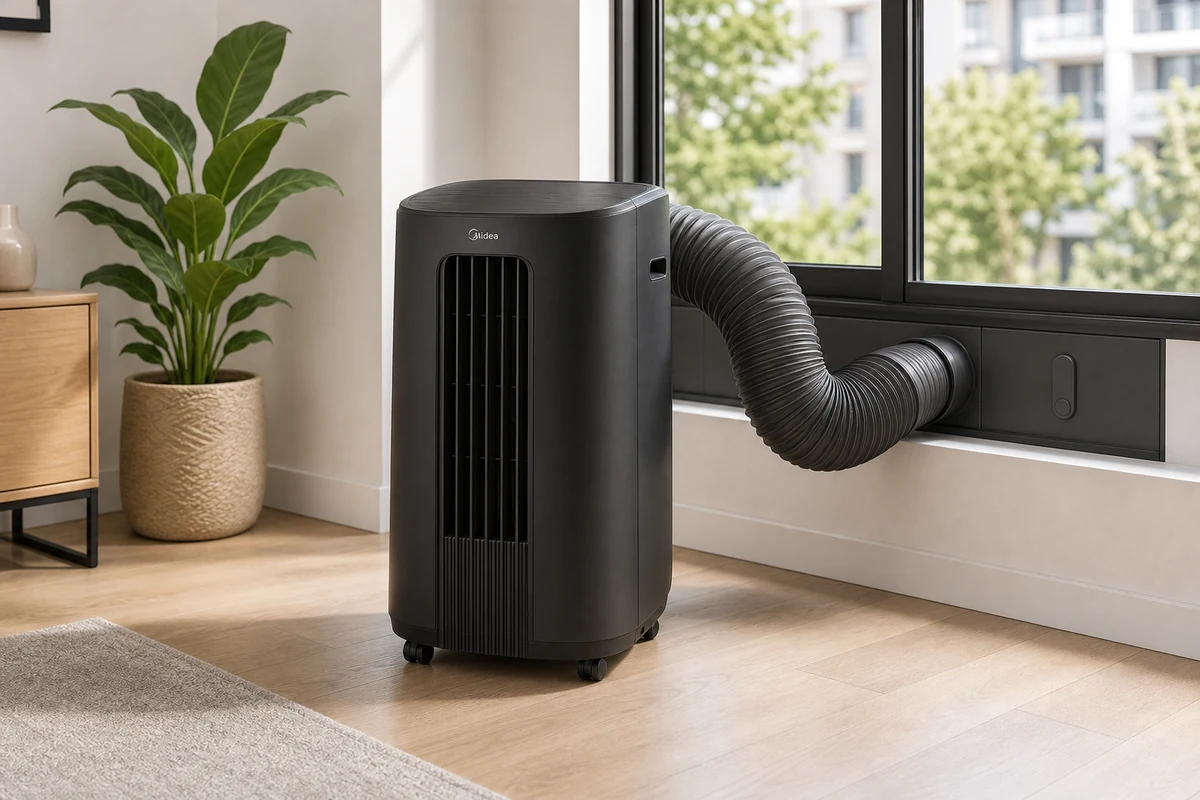
The portable that finally cools like it says on the box.
Most portables cheat: a single hose exhausts your own cooled air outside, pulling hot air back in through every gap. The Duo's hose-in-hose design is a true dual-hose system in one tube — intake and exhaust both outdoors — which is why its 12,000 SACC BTUs lead every portable on the market in measured real cooling, per Consumer Analysis's instrumented testing, at a SACC-per-watt ratio (9.2) no 14K-class rival touches. In practice that means it does what portables are famous for failing at: pulling a genuinely hot, humid room down and holding it. Forbes' Florida tester crowned it best overall in 2026 for exactly that — ice-cold output that reached the end of a hallway — and the inverter lets it idle quietly at 42 dB once the room settles. The app, Alexa/Google control, a five-piece window kit and full-surface window insulation (which no competitor includes) round out an unusually complete package. The format's costs still apply. It's 85 pounds and nearly three feet tall, the highest fan speed is unmissably loud while it works, and at $659 list you're paying window-flagship money for physics that still trail a window unit. But if the window is off-limits, this is the ceiling of what portable cooling currently does.
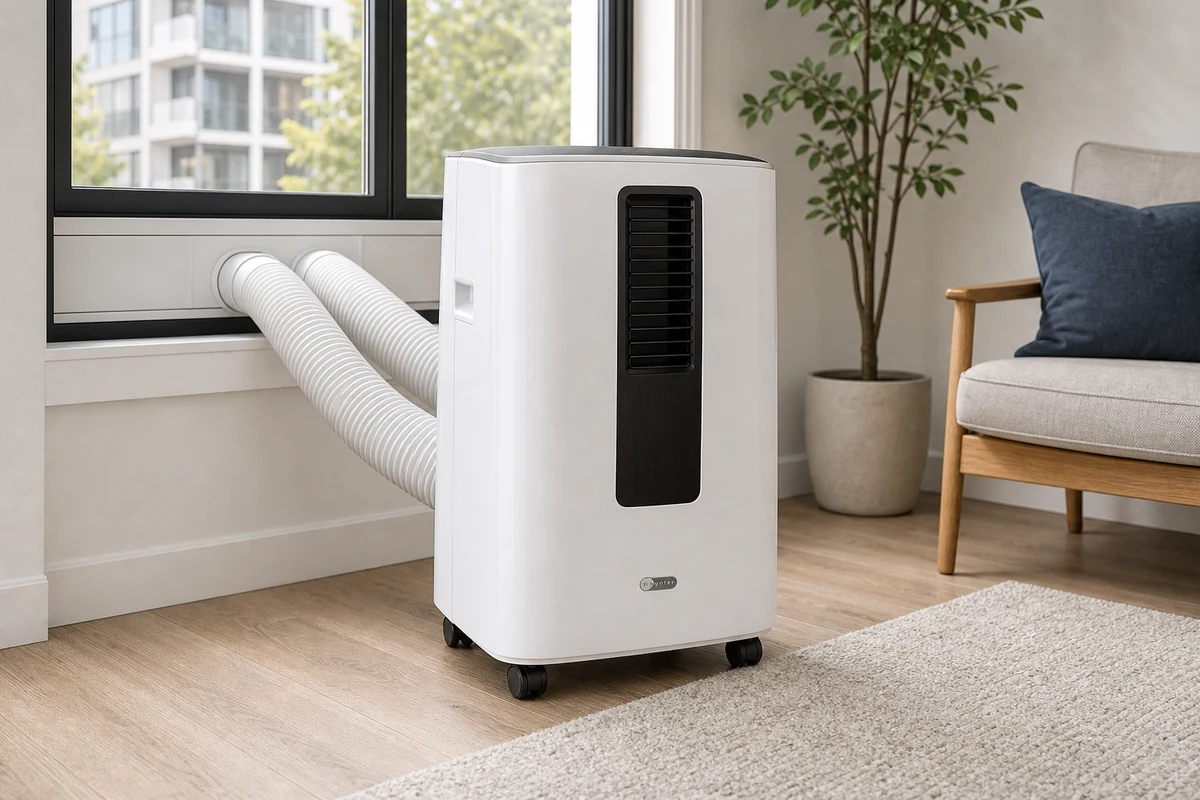
The lab-test champion of portables — built for the rooms that punish them.
If the Duo is the efficiency story, the ARC-1230WN is the brute-force one. TechGearLab measured an 11.9°F drop in 60 minutes — the biggest of any portable it tested, an Editors' Choice result — and Rtings currently ranks it the best portable AC it has tested. For west-facing rooms, top-floor bakes, and garages that defeat lesser portables, this is the unit that keeps up. Whynter's hose-in-hose NEX design gives it the same true dual-hose physics as the Duo, and it beats the Duo on livability details: the hose comes pre-installed and stows away on the unit for storage, the window kit seats in five to ten minutes (best install in TechGearLab's lineup), and an 80° auto-swing louver spreads air a fixed vent can't. Wi-Fi with Alexa and Google runs through the NetHome Plus app. Where it gives ground: it's mid-pack on energy efficiency — the inverter helps, but the Duo is measurably cheaper to run — and at 73–77 pounds with rear-mounted attachments it's awkward on stairs. At around $556, it's the pick when your problem is heat, not your power bill.
How we grade
We research every unit against manufacturer spec sheets and independent lab testing, normalize marketing claims to comparable numbers (SACC instead of ASHRAE for portables, measured dB instead of 'whisper quiet'), and score each unit on six weighted criteria. We have not run hands-on lab tests ourselves; rankings synthesize spec documentation and independent-review consensus.
Read the full methodology →We use cookies and similar technologies to understand how you use PickGrade, improve the experience, and measure the performance of our recommendations. Read our cookie and affiliate disclosure.