Buying guide
The Best Dehumidifier for a Basement
Reviewed by
Dr. Yocheved Yorkovsky · Science Editor, Health, Chemistry & Environment
Basements need capacity, hands-off drainage, and tolerance for cool air. Here's the pick — and the one question that decides which unit you buy.
 Match a dehumidifier to my basement →
Capacity and pricing checked July 2026.
The question that decides everything
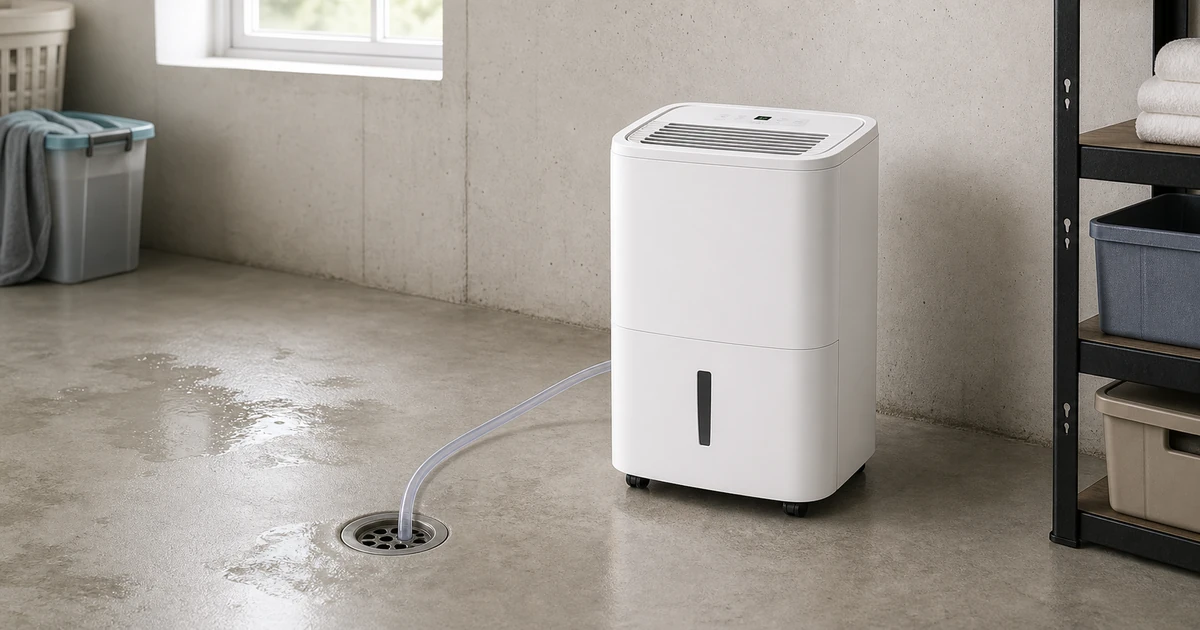
Before capacity, before brand, before price, answer this: is there a floor drain, or a sink, below where the unit will sit?
If yes, you can run a gravity hose and any decent 50-pint will quietly drain itself forever. If no — and a great many basements have no low drain — then a gravity hose is useless, and you are either carrying a bucket up the stairs every day or you are buying a pump. That single fact splits the entire decision.
What a basement demands
Basements are the hardest job in the category. They're large, they're often the dampest space in the house, and they run cooler than the rooms above. That means three requirements: real capacity (a 50-pint under the 2019 DOE standard), drainage you don't have to babysit, and tolerance for cool air.
Quick picks with comparable data
| Dehumidifier | Capacity (2019 DOE) | Drainage | Days between empties | Price |
|---|---|---|---|---|
| Midea Cube 50 | 50 pints/day | Built-in pump + hose | 0.67 | $299.99 |
| Frigidaire FHDD5034 | 49.7 pints/day | Gravity hose only | 0.43 | $271 |
| Ivation IVADDH06 | 12 pints (desiccant) | Gravity hose | 0.32 | $289.99 |
The pick: Midea Cube 50 with pump
For most basements, the Midea Cube 50 with pump is the answer, and the pump is the reason. It lifts condensate up to sixteen feet through the included tube, so it drains into a laundry sink or out a window with no floor drain in reach. Add a 4.2-gallon collapsible reservoir for the weeks you'd rather not run a hose, near-silent operation at 42–49 dB, and ENERGY STAR Most Efficient certification, and it's genuinely set-and-forget.
The value alternative: Frigidaire FHDD5034
If a floor drain does sit below the unit, you don't need the pump — and the Frigidaire FHDD5034 is the better buy. It's certified at 49.7 pints a day, costs $29 less, and delivers the most capacity per dollar in the category. Run a gravity hose to the drain and it's just as hands-off. We put the two head to head.
The bucket math, if you skip the hose
Both of these fill fast. We divided tank size by daily capacity across the category and found the Cube 50 runs about 0.67 days between empties and the Frigidaire about 0.43 — that is, twice a day. Nobody keeps that up. In a basement, plan on a hose or a pump; the tank is a backup, not a plan.
If the basement is genuinely cold
An unheated basement that dips toward 40°F in winter will stall a compressor into constant defrost. Neither pick above will save you. For that, a desiccant like the Ivation IVADDH06 keeps working down to 33°F — though at only 12 pints a day and 270 sq ft of coverage, it's a spot tool, not a whole-basement machine.
Watch and verify
- Midea Cube dehumidifier review and setup — pump and drain hose in use
- Frigidaire FHDD5034 review — hands-on testing
Sources
- ENERGY STAR certified dehumidifiers — verified capacity and efficiency figures
- EPA: mold and moisture — keep basements below 60% RH
- HouseFresh: Midea Cube 50 review — measured noise and power draw
Bottom line
No low drain: buy the Cube 50 and stop thinking about it. Low drain available: buy the Frigidaire and save $29. Genuinely cold basement: neither — you need a desiccant. Not sure which describes yours? The quiz asks in plain terms.
Frequently asked
What size dehumidifier for a basement?
A 50-pint (2019 DOE) suits most basements up to about 2,500 sq ft. A properly wet or larger basement should run a 50-pint continuously with a drain hose. Add roughly 5 pints of capacity because below-grade spaces run damper and cooler than their square footage suggests.
Do I need a pump for a basement dehumidifier?
Only if there's no floor drain or sink below the unit. A pump actively lifts water up to a higher sink or out a window. With a low drain, a simple gravity hose does the same job for less — which is why the pump is the single biggest decision here.
Will a dehumidifier work in a cold basement?
A standard compressor loses efficiency below about 50°F and mostly stops near 40°F, because the coil frosts over. For a genuinely cold basement you need a desiccant, which keeps working down to about 33°F.
How often will I have to empty a basement dehumidifier?
Twice a day or more if you rely on the bucket — a 50-pint unit fills its tank in well under a day at full output. In a basement, treat continuous drainage (a hose or a pump) as essential rather than optional.