Buying guide
The Best Dehumidifier for a Garage or Cold Room
Reviewed by
Dr. Yocheved Yorkovsky · Science Editor, Health, Chemistry & Environment
Cold rooms break normal dehumidifiers. Here's the technology that keeps working when the temperature drops — and the numbers behind it.
 Match a dehumidifier to my space →
Performance data checked July 2026.
Why a garage breaks a normal dehumidifier
A garage, workshop, or crawl space has one property that defeats most dehumidifiers: it gets cold.
A standard compressor works by condensing moisture onto a chilled coil. As the room drops toward 40°F, that coil frosts over. The unit then spends more and more of its time running a defrost cycle instead of drying, and eventually stops pulling meaningful water at all. This is the single most common dehumidifier complaint we see, and it isn't a defect — it's the physics of the design. So the usual advice, "just buy a big 50-pint," fails here.
The numbers, side by side
| At 41°F | Water removed per day |
|---|---|
| Desiccant (Ivation IVADDH06) | 11.8 pints |
| Comparable compressor | ~2.9 pints |
That's roughly a fourfold difference, and it's the entire reason this page exists. (Figures are Ivation's own; no independent lab has tested this model — see Sources.)
The pick: Ivation IVADDH06 desiccant
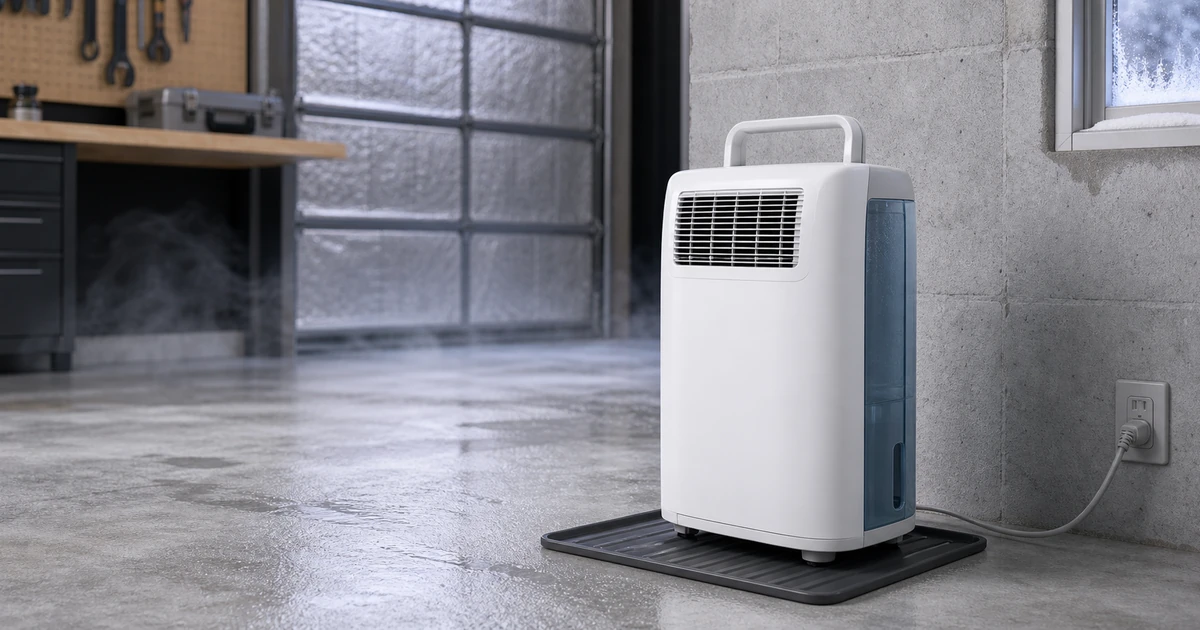
A desiccant dehumidifier has no cold coil. It absorbs moisture onto a slowly rotating wheel, so there is nothing to frost over. The Ivation IVADDH06 is the most available true 120V desiccant in the US, and it keeps operating down to 33°F — one degree above freezing.
Two bonuses in a garage: it weighs about eleven pounds, so it moves one-handed, and it warms its exhaust slightly, which is welcome in a cold space. A continuous drain hose is included — which matters, because you won't be out there checking a bucket.
The honest costs
A desiccant is not a free win, and you should know what you're buying.
It's small. About 270 sq ft of coverage. This is a tool for one garage bay, a crawl space, a boat, or an unheated room — not a three-car garage.
It's thirsty. Up to 470 watts for around twelve pints a day makes it the most expensive unit in our ranking to run per pint. Desiccants trade efficiency for cold-weather ability, and there's no way around that.
It's expensive, at about $290 — the priciest per pint in the category.
If the garage stays warm
If your garage rarely drops below about 60°F — a mild climate, or an attached, semi-heated one — don't buy a desiccant. A compressor is cheaper to buy, far cheaper to run, and pulls four times the water. The Frigidaire FHDD5034 is rated to 41°F and handles a warm garage comfortably. We put the two technologies head to head.
Plan the drainage
Garages rarely have a convenient sink. Either run the included gravity hose to a floor drain, or accept that you're emptying a tank — and the Ivation's tank is small, at about a third of a day's output. A hose is strongly preferable here.
Sources
- Ivation IVADDH06 product specifications — the 33°F minimum and cold-weather figures (manufacturer data)
- ENERGY STAR certified dehumidifiers — the Frigidaire's verified 49.7-pint rating
- Note on evidence: no major editorial outlet has lab-tested the IVADDH06. We rate it on the well-established physics of desiccant operation and mark our confidence accordingly.
Bottom line
If the space gets genuinely cold, the Ivation desiccant is the only thing on this list that will actually pull water out of the air — buy it, run the hose, and accept the running cost. If the garage stays above 60°F, buy the Frigidaire instead and save money twice. The quiz asks how cold it gets and picks the right technology.
Frequently asked
Why won't my dehumidifier work in the garage?
If the garage is cold, a standard compressor frosts up and stalls below about 40°F — it spends its time defrosting instead of drying. You need a unit rated for low temperatures, ideally a desiccant, which works down to about 33°F.
What's the best dehumidifier for a cold garage?
A true desiccant like the Ivation IVADDH06. It absorbs moisture on a rotating wheel rather than a cold coil, so it keeps working to 33°F — pulling around 11.8 pints a day at 41°F, where a compressor manages under three.
Can I use a regular dehumidifier in an unheated space?
Only if it stays above roughly 50°F. Below that, compressor performance drops sharply and becomes negligible near 40°F. A desiccant is the reliable choice for genuinely cold rooms.
Are desiccant dehumidifiers expensive to run?
Yes — noticeably more than a compressor. They draw around 470 watts for a modest output, making them the priciest option per pint of water removed. You're paying for the ability to work in the cold, which no compressor can match.