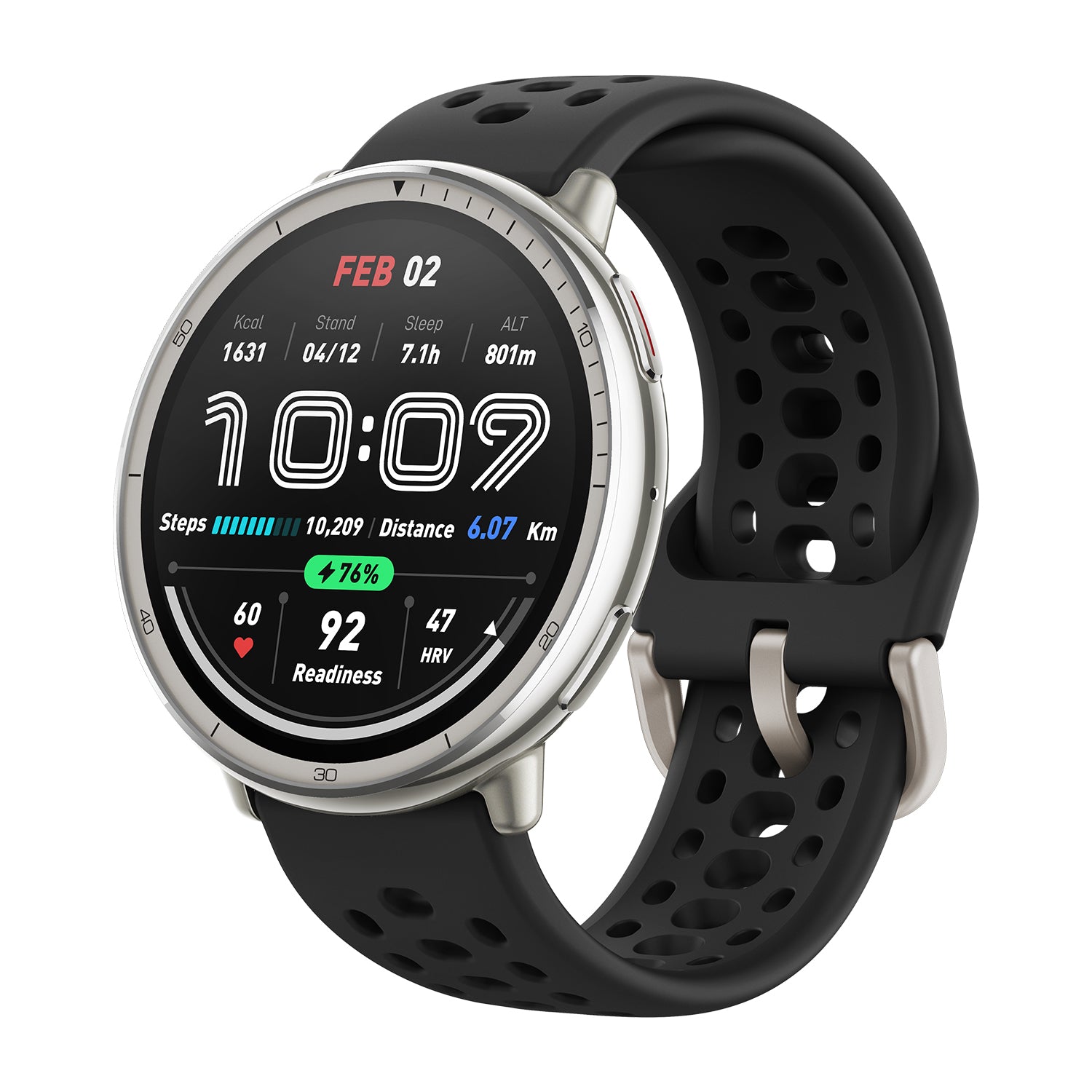
Built-in GPS, offline maps, and a bright AMOLED for $99 — the value pick that embarrasses pricier watches.
Amazfit Active 2
Amazfit
The most tracker you can buy for $99: a stainless-steel AMOLED watch with real built-in GPS, offline maps, and no subscription — features that cost far more elsewhere. Heart rate lags in hard intervals and the app is cluttered, but the value is hard to argue with.
The Active 2 is the clearest "Moneyball" pick in the category: a $99 watch with a stainless-steel case, a bright 1.32-inch AMOLED (2,000 nits), and — the part that matters — genuine built-in GPS with downloadable offline maps and turn-by-turn navigation, a feature you normally pay two or three times as much for. Add 160+ sport modes (including HYROX), SpO2, sleep with HRV, a barometer, and Zepp Flow, an OpenAI-powered voice assistant, and the spec sheet reads like a watch costing $250. There's no subscription; all the data is free in the Zepp app. The compromises are the usual budget ones. Zepp's interface is powerful but cluttered, turn-by-turn prompts and auto-detection are hit-or-miss, and — like every wrist sensor here — heart rate lags during hard intervals, so serious interval training still wants a chest strap. The standard model skips NFC (the $129 Premium adds sapphire glass and Zepp Pay). Battery is a rated 10 days, realistically 6–7 with the always-on display. None of that undercuts the core point: for phone-free GPS tracking and a proper AMOLED screen at $99, nothing touches it. TechRadar and Tom's Guide both call it the bang-for-buck champion, and it's why it's our value pick.
$99
PickGrade may earn a commission from purchases made through links on this page, at no extra cost to you. This never affects our grades. Full disclosure.
Last reviewed Jul 1, 2026
What we like
- ✓Real built-in GPS and offline maps at a $99 price point
- ✓Bright 2,000-nit AMOLED and a premium stainless-steel case
- ✓Up to 10-day battery and no subscription whatsoever
- ✓160+ sport modes plus an actually-useful AI voice assistant
Trade-offs
- −Heart rate lags during hard intervals — chest strap for serious training
- −Zepp app is powerful but cluttered, and auto-detection is inconsistent
- −No NFC payments unless you buy the $129 Premium
- −Turn-by-turn navigation prompts fire only about half the time
Best for
you want phone-free GPS runs, offline maps, and a bright screen for as little money as possible, and you'll skip a chest strap.
Avoid if
you need chest-strap-grade heart rate for interval training, or you want a clean, polished app and NFC payments out of the box.
Score breakdown
- value9.2/10
- battery life8.5/10
- comfort design7.5/10
- app experience7.0/10
- health insights7.0/10
- tracking accuracy7.0/10
Specs
- ECG
- false
- NFC
- Premium model only ($129)
- Case
- Stainless steel, ~30 g
- Extras
- Zepp Flow AI voice assistant; on-wrist calls
- Display
- 1.32" AMOLED (466×466), 2,000 nits
- Sensors
- Optical HR, SpO2, sleep HRV, stress, skin temp, barometer
- Released
- 2025
- Sport modes
- 160+ incl. HYROX
- Battery life
- Up to 10 days (≈6–7 real-world); 21 h GPS
- Built-in GPS
- Yes — 5-satellite, with offline maps
- Subscription
- None — all data free in the Zepp app
- Compatibility
- iOS and Android
- Water resistance
- 5 ATM (50 m)
How we know
High confidenceLast checkedVerdict: the best value in the category — a genuine built-in-GPS watch for $99 with no strings. The review consensus is emphatic. TechRadar handed it five stars and called $99 the price that makes it "a pure five-star pick"; Tom's Guide named it the best bang-for-the-buck smartwatch of its year; Notebookcheck dubbed it the "price-performance king." The recurring praise is that features usually reserved for pricier watches — a 2,000-nit AMOLED, a stainless-steel case, built-in GPS with offline maps — arrive here for a fraction of the cost, with no subscription. The caveats are consistent too. Reviewers note heart rate can read low during high-intensity intervals (a wrist-optical limitation across all brands), Zepp's software is feature-dense but clunky, and turn-by-turn navigation is unreliable. On The Quantified Scientist's testing, heart-rate correlation was solid for steady indoor work but dropped during outdoor running and cycling. Battery lands around 6–7 real-world days with the always-on display — short of the 10-day rating but still strong. For a buyer who wants phone-free GPS and a real screen without spending $200, the value case is close to unanswerable.
Other expert reviews
Video reviews
The Quantified Scientist — Amazfit Active 2 – Long-term Scientific Review
From real owners
Human reviews that sharpen our AI grade
No owner reviews yet. Be the first to share what you think.
Own this? Write a review
Related guides
All fitness trackers reads →Was this review useful?