How Much Does a Dehumidifier Cost to Run? (With the Actual Math)
A dehumidifier is one of the hungrier appliances in the house. Here's how to calculate what yours costs — and why the humidistat is the setting that saves you money.
By Dr. Yocheved Yorkovsky · Science Editor, Health, Chemistry & Environment
July 11, 2026 · Openly AI-powered
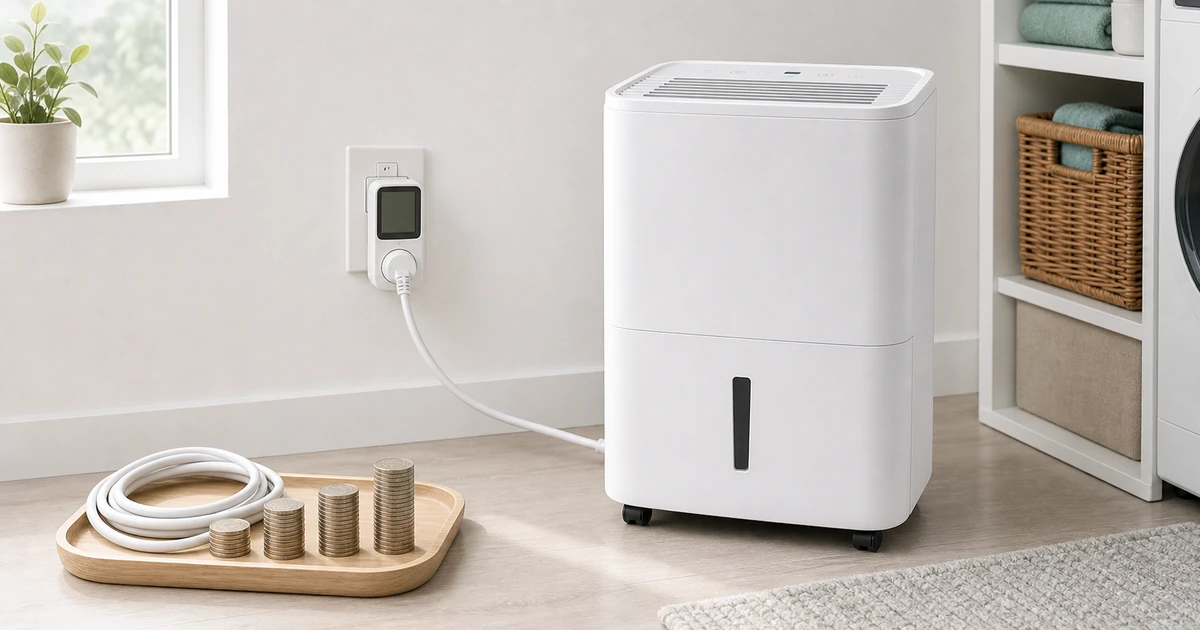
A dehumidifier that runs through a damp season is quietly one of the more expensive appliances you own to operate — often more than the fridge. The good news is the math is simple, and one setting does most of the saving.
The formula
Running cost comes down to three numbers: the unit's power draw in watts, how many hours it runs, and your electricity rate.
Cost per day = (watts ÷ 1000) × hours × rate per kWh.
A worked example
Take a common 50-pint unit that draws about 500 watts, and the current U.S. average residential electricity rate of roughly 18.8 cents per kWh (per the EIA).
- Running 12 hours a day: 0.5 kW × 12 h = 6 kWh → 6 × $0.188 ≈ $1.13 a day, about $34 a month.
- Running 24 hours a day: 12 kWh → about $2.26 a day, roughly $68 a month.
Smaller units cost less (a 20-pint might draw 300 watts), and desiccants cost more (they run around 600 watts, trading efficiency for cold-weather performance).
The setting that saves you money
Here's the part most people miss: those figures assume the unit runs the whole time. It shouldn't. Set the humidistat to a sensible target — 45–50% relative humidity is plenty to prevent mold and dust mites — and the dehumidifier cycles off once it reaches that level, only running when humidity climbs back up. In a moderately damp room, that can cut real runtime, and therefore cost, by half or more. A unit left in "continuous" mode with no target is the one that runs up a bill.
Efficiency, and where to check it
If running cost matters to you, look for an ENERGY STAR label and, on the spec sheet, the Integrated Energy Factor (IEF) in liters per kWh — higher is better. The most efficient units here, like the Midea Cube line, are ENERGY STAR Most Efficient and noticeably cheaper to run over a season than budget models pulling the same water.
The bottom line
Budget somewhere between $15 and $70 a month for a full-size unit in real use, depending on size, runtime, and your local rate — and lean on the humidistat to keep it near the low end. If you want the efficient picks, the full ranking scores every unit on energy use.