Buying guide
Best Air Purifiers for Pet Hair and Dander
Reviewed by
Dr. Yocheved Yorkovsky · Science Editor, Health, Chemistry & Environment
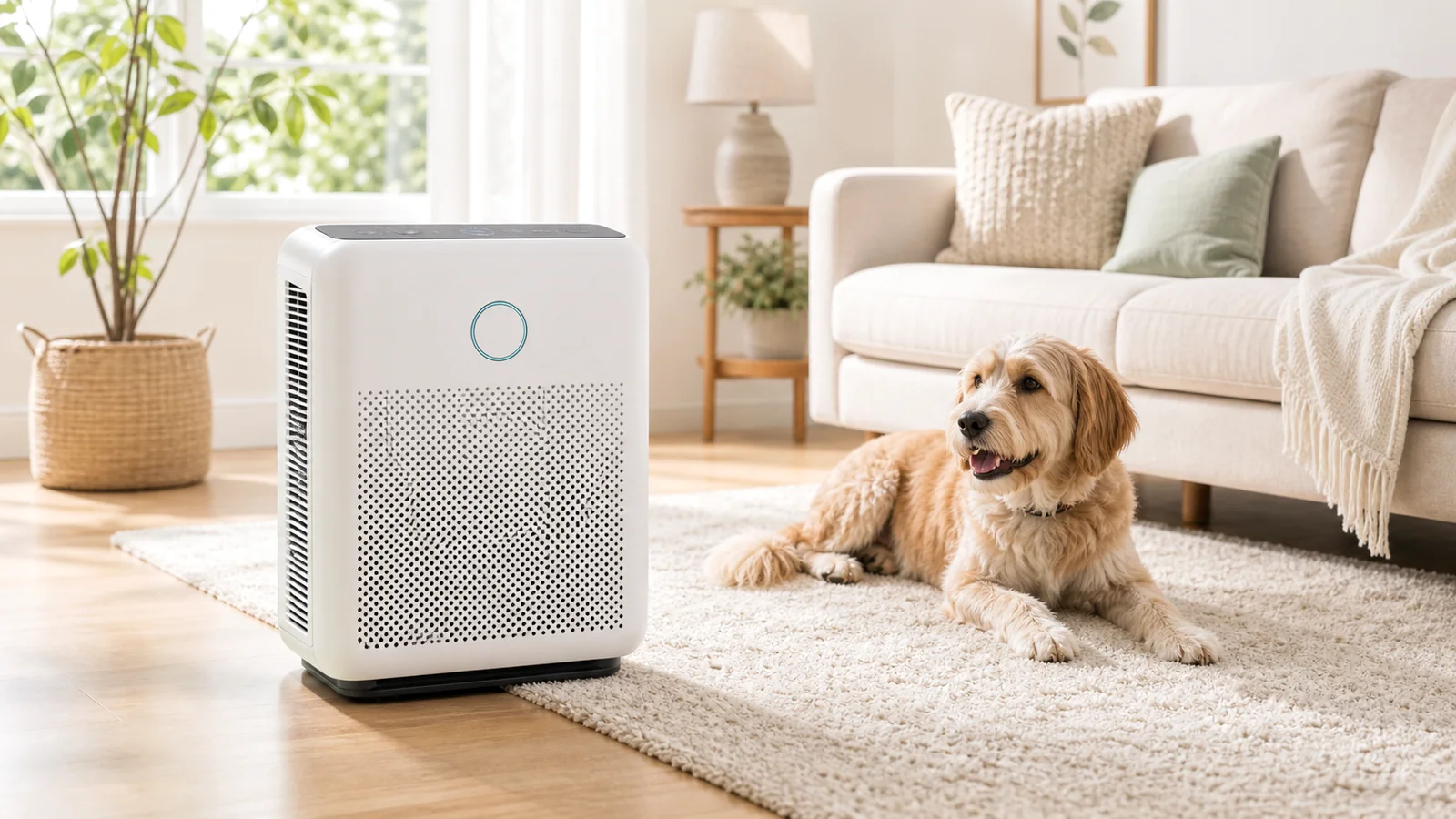
For pet homes, the right air purifier is sized for the room, quiet enough to leave running, and ideally has a washable pre-filter that catches fur before it clogs the HEPA. Here are the picks by room size, with the pet-specific features that actually matter for dander, hair, and odor.
 Find your air purifier →
The short answer
For most pet homes, the Winix 5510 ($180) is the pick to beat: it's the rare purifier with a washable mesh pre-filter that traps loose fur before it clogs the expensive HEPA, plus a real carbon layer for odor and ~370 sq ft of coverage. Independent testers (HouseFresh) measured roughly 248 cfm of clean-air output, and it took #1 in Project Farm's comparison test.
The rest of the shortlist, by room:
- Best overall for pets: Winix 5510, $180. Washable pet pre-filter, True HEPA, carbon for odor, smart auto mode.
- Quiet bedroom pick: Coway Airmega AP-1512HH, ~$175. A verified 233.6 cfm in ~360 sq ft, quiet enough to run all night.
- Big living room: Levoit Core 600S, $300. ~410 cfm clears 600+ sq ft, with app and auto mode for open-plan pet spaces.
- Big room on a budget: Blueair Blue Pure 211+ Auto, $300. ~540 sq ft and also a washable pre-filter, a strong large-room match for shedding homes.
- Small bedroom or nursery: Levoit Core 300S, ~$130. Bedroom-sized, quiet, full smart suite on a nightstand.
Skip tiny desk units like the Levoit Core Mini for whole-room pet duty; they can't move enough air to matter past a desk.
What an air purifier does (and doesn't) for pets
An air purifier doesn't vacuum fur off the floor. Its job is to pull airborne particles through a filter: pet dander, the fine hair that stays suspended, dust, and (with carbon) some odor. Dander is the real target: it's the microscopic skin flakes that trigger most pet allergies, and it floats long enough to be captured. Floor hair still needs a vacuum.
Here's the part I care about most as a chemist: the thing triggering the allergy isn't the hair, it's a protein (Fel d 1 from cats, Can f 1 from dogs) carried on dander and dried-saliva flakes light enough to stay airborne for hours. That's why vacuuming alone never fixes pet allergies and filtration does: you're capturing a particle that floats. And it's why the two filters inside these machines do two genuinely different jobs: HEPA is mechanical (it physically traps the particle), while activated carbon is molecular adsorption (it binds the gas-phase molecules behind odor). Neither does the other's work, so a pet home usually needs both.
That reframes the whole decision. The best purifier for pets isn't the most powerful one; it's the one sized for the room and quiet enough that you actually leave it running where your pets spend their time. A strong unit that's too loud ends up switched off; a tiny one on low does nothing in a living room. Fit beats specs.
The picks in depth
Winix 5510: the pet owner's value pick
~248 cfm (HouseFresh) · ~372 sq ft · washable pre-filter + True HEPA + AOC carbon + PlasmaWave · ~41 dBA quiet / ~67 dBA turbo · ~$50/yr filters · smart app + auto mode · $180
The Winix 5510 is the pet home's secret weapon because of one feature: a washable mesh pre-filter sits in front of the HEPA and catches loose fur and large dust before they reach the expensive filter. In a shedding house that's the difference between rinsing a screen and replacing a clogged filter early. Behind it sits a True HEPA filter and a pelleted AOC activated-carbon layer for odor, plus a smart app, auto mode, and an air-quality sensor. It topped Project Farm's independent test and HouseFresh clocked it clearing their test room in 24 minutes. The honest trade-offs: it's loud at full speed (~67 dBA), cleaning slows at whisper-quiet speeds, and the app is basic. At ~$180 with ~370 sq ft of coverage, nothing matches its price-to-performance for pets.
Coway Airmega AP-1512HH: the quiet bedroom workhorse
Verified 233.6 cfm smoke CADR · ~360 sq ft · True HEPA + carbon · quiet at usable speeds · ~$175
If pet dander is mostly affecting your sleep, the Coway AP-1512HH is the safe bedroom pick: a verified 233.6 cfm in a room up to ~360 sq ft, quiet enough to run continuously through the night, with simple controls and a True HEPA + carbon stack. It's the model reviewers have trusted for years for exactly this job: enough clean air, tolerable noise, sane price.
Levoit Core 600S: the open-plan living room
~410 cfm · 600+ sq ft · True HEPA + carbon · app, auto mode, air-quality sensor · $300
For a big living room or open floor plan where pets roam, the Levoit Core 600S has the airflow smaller bedroom units lack: ~410 cfm clears 600+ sq ft fast, and the app plus auto mode let it ramp up on its own when dander and cooking smells spike. The large-room pick when a bedroom-sized purifier would just be overwhelmed.
Blueair Blue Pure 211+ Auto: big-room value
~540 sq ft · HEPASilent filtration · washable pre-filter · simple auto mode · $300
The Blueair 211+ Auto is the other strong large-room answer for pet homes, and it shares the Winix's best trick: a washable pre-filter that catches fur before the main filter. It covers ~540 sq ft with Blueair's quiet HEPASilent design and a simple, no-app auto mode. Pick it over the 600S if you'd rather skip the smart-home setup.
Levoit Core 300S: the nightstand option
Bedroom-sized · True HEPA + carbon · app, auto mode, sleep mode · quiet · ~$130
For a smaller bedroom or a nursery, the Levoit Core 300S fits on a nightstand, runs quietly, and still brings the full smart suite (app, auto mode, sleep mode, and an air-quality sensor) for around $130. The right size for a single room where the 600S would be overkill.
The washable pre-filter is the pet-specific feature
If you take one thing from this page: in a shedding home, a washable pre-filter matters more than almost any other feature. Pet hair is large and clogs HEPA filters fast, and a clogged filter both costs money to replace and chokes airflow long before its rated life. A washable mesh screen catches that fur first, so you rinse it every couple of weeks instead of replacing the main filter early. The Winix 5510 and the Blueair 211+ both have one; most bedroom-class purifiers don't. That single feature is why the Winix punches so far above its price for pets.
Size it for the room, then run it often
Match clean-air output to the space before comparing brands. The quick rule for an 8-foot ceiling: aim for a smoke CADR of at least two-thirds of the room's square footage. A 14×16 living room (224 sq ft) wants ~150 cfm minimum, and pet homes benefit from extra headroom so the unit can run on a lower, quieter speed most of the time and only ramp up when needed. The room-size calculator does the math for your space. The goal is a purifier you can leave on, because air cleaning is a function of fan speed times run time: a quieter unit you never turn off beats a louder one you switch off.
Don't skip carbon if odor is part of the problem
Pets mean odor, and HEPA filtration does nothing for smells: that needs activated carbon. A thin carbon-coated mat helps a little; a deeper carbon bed helps more. All the picks here include a meaningful carbon stage, which is why they make the list over particle-only units. If litter box or "wet dog" odor is your main complaint, weight carbon depth heavily and set realistic expectations: carbon reduces odor, it doesn't erase it.
Budget for filters, not just the purchase
Pet homes clog filters faster, so the cheap-up-front purifier with pricey filters can cost more over a year than a pricier model with affordable ones. Check two numbers before buying: the replacement filter price and how often you'll swap it. This is exactly where the washable pre-filter pays off: the Winix runs about $50/year in genuine filters, and rinsing the pre-filter stretches the main HEPA's life well past what it'd manage catching fur directly.
Bedroom vs living room
Where the purifier runs changes the priority. For a bedroom, weight quiet operation and dimmable lights; the Coway and Core 300S are easy picks. For a living room, weight coverage and airflow; the 600S or Blueair 211+. For pet dander that disrupts sleep specifically, put a quiet, properly-sized unit in the bedroom and run it continuously; that does more than a bigger purifier two rooms away.
The panel: two lenses I don't own
The air and the chemistry are mine, but the money and the day-to-day fit aren't, so I asked my co-editors.
Eran Yorkovsky, Value & Longevity lens: "The washable pre-filter isn't a convenience feature, it's the value argument. Pet hair clogs a HEPA fast, and the clogged filter you replace early is the cost nobody quotes you. A $180 Winix whose pre-filter you rinse runs about $50 a year; a cheaper purifier without one can cost more than that over three years. Price the filters, not just the box."
Michal Zucker, Design & Fit lens: "The best purifier is the one you never switch off, and that's a noise-and-placement call, not a spec-sheet one. If it's too loud for the bedroom, you'll turn it off at night, which is exactly when dander settles around you as you sleep. Size up so it runs quiet on a low speed, and put it where your pet actually lives, not where it looks tidy."
How we picked
No lab, no theater: here's the process behind these picks, so you can weigh how much to trust them.
- Clean-air output verified against AHAM CADR figures and independent measurements (HouseFresh, Project Farm) rather than brand coverage claims.
- Pet-specific features checked against manufacturer documentation: washable pre-filter, carbon depth, noise at usable speeds, and real filter cost.
- Owner complaints scanned for the recurring clogging, noise, and filter-cost patterns a shedding home actually hits.
- Graded on PickGrade's three lenses: Value & Longevity, Design & Fit, and Health & Environment.
- We don't fake hands-on testing. PickGrade doesn't run its own lab and never pretends to; my job is to hold the claims up against the chemistry and the independent data.
Last updated: July 2026.
Still choosing?
Take the quiz and we'll match you by room size, how much your pet sheds, whether odor is a factor, and your noise tolerance.
- Take the air purifier quiz
- Best large-room air purifiers: for open living spaces
- Best bedroom air purifiers: quiet picks for sleep
- Best air purifiers under $250: the value tier
- Air purifier room-size calculator
- See all air purifiers we cover
Frequently asked
Do air purifiers remove pet hair?
Air purifiers capture airborne pet dander, fine suspended hair, dust, and (with carbon) some odor, but they don't pick hair up off floors or furniture, so you still need to vacuum. Dander is the real target, since it's the microscopic allergen that floats long enough to be filtered. The most useful pet feature is a washable pre-filter, which catches loose fur before it clogs the main HEPA.
Do air purifiers actually help with pet allergies?
Yes, meaningfully, because the pet allergen is a protein (Fel d 1 in cats, Can f 1 in dogs) carried on tiny dander flakes that stay airborne for hours: exactly the particles a True HEPA filter is designed to capture. A purifier won't cure an allergy or replace vacuuming and washing bedding, but a correctly-sized HEPA unit run continuously in the room where you spend the most time measurably lowers the airborne allergen load. Prioritize HEPA, enough CADR for the room, and quiet enough to leave on.
What is the best air purifier for pet hair?
For most pet homes the Winix 5510 (~$180) is the best value: it has a washable mesh pre-filter that traps fur before the HEPA, a carbon layer for odor, and roughly 248 cfm of clean-air output for rooms up to ~370 sq ft. For a large living room, step up to the Levoit Core 600S or Blueair 211+; for a quiet bedroom, the Coway AP-1512HH or Levoit Core 300S.
Do I need a carbon filter for pet odors?
Yes, carbon filtration is what handles pet odor. HEPA filters capture particles like dander and hair but do nothing for smells, so for litter box, 'wet dog,' or general pet odor you need a meaningful activated-carbon stage. A deeper carbon bed helps more than a thin carbon-coated mat. Carbon reduces odor rather than eliminating it, so set expectations accordingly.
What room should I put a pet air purifier in?
Put it in the room where your pet spends the most time, or in the bedroom if pet dander disrupts your sleep. For dander-related allergies at night, a quiet, properly-sized purifier running continuously in the bedroom does more than a larger unit in another room. Air cleaning depends on fan speed and run time, so the best placement is wherever you'll actually leave it on.
How often will I replace filters in a pet home?
Pet homes clog filters faster than average, so check both the replacement filter price and the swap interval before buying. A model with a washable pre-filter, like the Winix 5510 or Blueair 211+, catches loose fur first so you rinse a screen instead of replacing the main HEPA early: the Winix runs about $50 a year in genuine filters that way. Without a pre-filter, expect more frequent (and pricier) HEPA replacements in a shedding home.
What is a washable pre-filter and why does it matter for pets?
A washable pre-filter is a mesh screen in front of the main HEPA that catches large particles like pet hair and dust before they reach it. It matters most in shedding homes because pet hair clogs HEPA filters quickly: rinsing a reusable screen every couple of weeks keeps airflow strong and extends the expensive filter's life. The Winix 5510 and Blueair 211+ both include one; most bedroom-class purifiers don't.