Buying guide
Best Small Air Purifiers for Desks, Bedrooms, and Tiny Rooms
Reviewed by
Dr. Yocheved Yorkovsky · Science Editor, Health, Chemistry & Environment
The best small air purifier is not always the smallest one. For a desk, a compact purifier can make sense. For a bedroom, CADR matters more than footprint. Here's how to size it, and where the good small ones actually work.
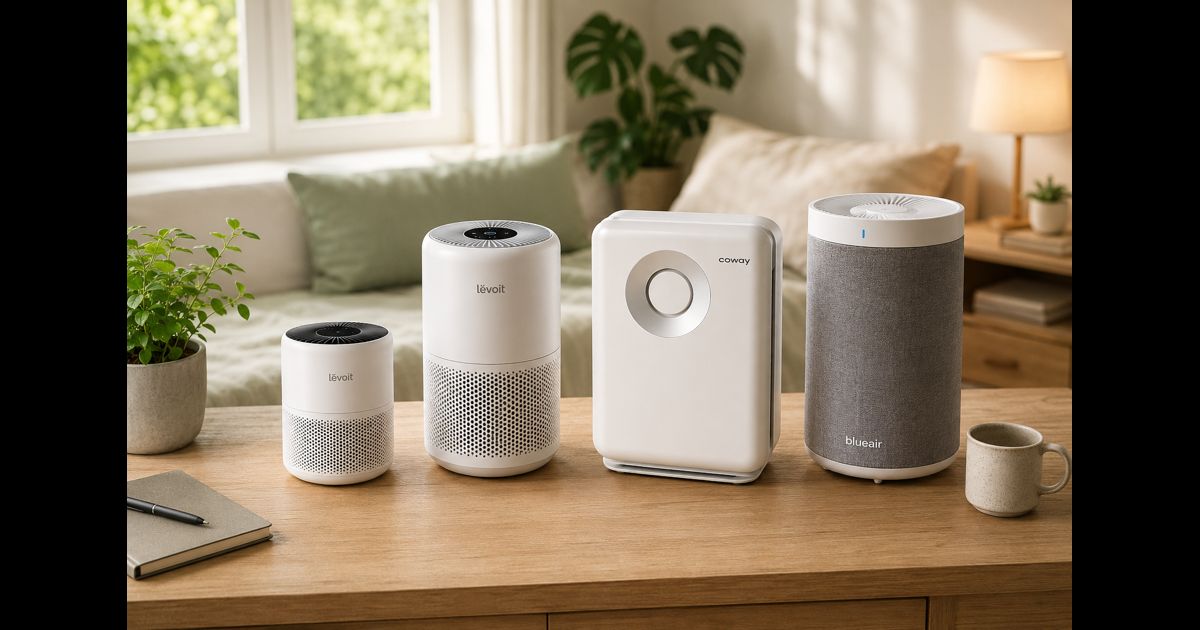 Compare small and bedroom purifiers →
The short answer
For a genuinely small, personal space, the Levoit Core Mini ($50) is the sensible pick: it cleans the air right in front of you at a desk or bedside, cheaply and quietly. If your "small" room is a real bedroom, the main recommendation is the Levoit Core 300S ($130). And if you want more airflow headroom for a small-to-medium room, the Coway AP-1512HH ($173) has the CADR to spare, with one caveat about its optional ionizer below.
- Best truly small (desk/nightstand): Levoit Core Mini, $50. ~45 CFM CADR, a personal-zone unit, not a room purifier.
- Best for a real small bedroom (the main pick): Levoit Core 300S, $130. ~141 CFM CADR, ~219 sq ft, no ionizer at all, near-silent sleep mode.
- Best airflow headroom: Coway AP-1512HH, $173. 233 smoke CADR, ~360 sq ft. Excellent airflow, but it includes an optional ionizer (run it off if you're avoiding ionization).
Small purifiers at a glance
| Pick | Honest use case | Key sizing fact | Caveat |
|---|---|---|---|
| Levoit Core Mini, $50 | Desk, nightstand, personal zone | ~45 CFM CADR (roughly 60 to 80 sq ft of real coverage) | Not a normal bedroom purifier |
| Levoit Core 300S, $130 | A real small bedroom or home office | ~141 CFM CADR, ~219 sq ft | 3-stage particle-and-carbon, zero ozone |
| Coway AP-1512HH, $173 | Small-to-medium room, airflow headroom | 233 smoke CADR, ~360 sq ft | Includes an optional ionizer (leave it off) |
For a quiet premium step-up into a larger room, see the bedroom and large-room guides.
"Small" is a coverage limit, not a feature
A small purifier is useful only when you're honest about the job. An air purifier's real job is measured by CADR, its clean-air delivery rate, which is just how much filtered air it pushes out per minute. To clean a room it has to cycle the room's whole volume of air several times an hour, and a tiny fan pulling air through a tiny filter simply can't do that for a real room, whatever the box says. So read "small" as "cleans a small volume of air," not "fits anywhere."
That gives you a clean rule. A desk-sized unit like the Core Mini is for a personal zone, the air within a few feet of you. A small room wants a bedroom-class purifier sized to the space. If you buy by how little counter it takes instead of how much air it moves, you get a device that looks like it's working and isn't.
A word on our grades, before you look at them
You'll notice the purifiers on this page grade lower than the big machines elsewhere on the site, and I'd rather explain that than have you wonder.
Our grade measures a purifier's absolute capability, and we weight clean-air delivery for the room at 30%. A small unit therefore always sits lower on the total, by design. That is not a verdict on whether it's the right purchase for you. The Core Mini grades modestly, and it is still exactly what you should buy for a desk, because in a personal zone the airflow it "lacks" is capacity you would never have used.
So on this page in particular, read the individual criteria rather than the headline number. A correctly-sized small purifier is a good buy with a modest grade, and that's the honest way to present it.
The picks in depth
Levoit Core Mini, the honest desk purifier
~45 CFM CADR · compact personal unit · quiet · ozone-free · $50
The Levoit Core Mini is the one small purifier I'd happily recommend, as long as you buy it for what it is: the air right in front of you. Its ~45 CFM CADR is the giveaway. By the standard two-thirds rule that's realistically somewhere in the region of 60 to 80 square feet of genuine coverage, a desk or a bedside, not a normal bedroom (Levoit markets it up to ~178 sq ft, but that figure assumes a much lower air-change rate than you actually want). On a desk, a nightstand, or a small bathroom shelf it quietly cleans your personal breathing zone for $50, with no ozone-producing gimmickry. Put it in the middle of a bedroom and expect it to clear the whole room, and it will disappoint you. Buy it for a person, not a room.
Levoit Core 300S, for a real small bedroom
~141 CFM CADR · ~219 sq ft · 3-stage particle-and-carbon · no ionizer, zero ozone · ~24 dB sleep mode · 26W · smart app · $130
If "small bedroom" means an actual bedroom, the Levoit Core 300S is the main pick for most readers. It moves real air (about 141 CFM CADR, rated for roughly 219 square feet), runs a genuinely quiet sleep mode (around 24 dB), draws just 26 watts, and adds a PM2.5 sensor and app if you want them, for around $130. Crucially, it has no ionizer at all: CARB certified, zero ozone, nothing to remember to switch off, which is the safer direction for a small enclosed bedroom or a nursery. This is the sweet spot most "small purifier" shoppers are actually looking for.
One tip that isn't on the box: its auto mode is lenient. The sensor will call air of around 35 µg/m³ "very good," which is well above WHO guidance, so the machine under-runs while you assume it's working. Run it on a manual speed.
Coway AP-1512HH, airflow headroom (with an ionizer caveat)
233 smoke CADR (AHAM-verified) · ~360 sq ft · washable pre-filter + carbon + True HEPA + optional Vital Ion · quiet at usable speeds · 3-year warranty · $173
The Coway AP-1512HH is the airflow pick: an AHAM-verified 233 CADR covers up to about 360 square feet, so in a small-to-medium bedroom it does the job on a low, quiet setting rather than roaring at maximum, and that headroom is the whole point. It also carries a 3-year warranty, the longest here.
One honest caveat for a health-first page: its filter stack includes an optional ionizer (Coway calls it Vital Ion). It ships off, and it should stay off, because ionizers can generate trace ozone, which is a lung irritant rather than a genuine cleaner. Run it with the ionizer off and you get an excellent, purely mechanical purifier. If you'd rather not own the feature at all, the Core 300S has no ionizer whatsoever. The full head-to-head is in Levoit Core 300S vs Coway AP-1512HH.
How to size a small purifier (the two-thirds rule)
You don't need to guess. For a standard 8-foot ceiling, aim for a smoke CADR of at least two-thirds of the room's square footage (AHAM's guidance). A 12 by 12 room is 144 square feet, so you want a CADR of about 96 or more. That one calculation tells you instantly whether a "small" purifier is honestly sized or wishful. Give yourself extra headroom if you want to run it quietly, since a purifier you leave on at a low speed beats a louder one you switch off. If you're on the line between a desk unit and a room purifier, the room-size calculator settles it.
What I'd skip
The small-purifier shelf is where the most dubious products hide.
- Skip ozone generators outright, especially in a small enclosed room. Ozone is a lung irritant, not a feature I want near a bed or a desk, and the EPA notes that ozone generators sold as air cleaners aren't approved for use in occupied spaces. I'm also cautious with ionizers and other electronic add-ons: some are certified to stay under ozone limits, but that certification isn't the same as proving they clean better or are the right choice for a sensitive user. (CARB itself says certification doesn't mean a device is effective or "safe to use.") Where a good purifier includes one, switch it off.
- Skip tiny USB "purifiers" with a thumb-sized fan and almost no filter. If there isn't real filter area and airflow, the styling is the product.
- Skip a small unit for a job it can't do: a full bedroom, smoke, or heavy pet dander. There a properly sized purifier is actually quieter and more effective because it isn't straining. For wildfire or cooking smoke, size up harder than usual, since AHAM recommends a smoke CADR equal to the room's full square footage, not two-thirds. See the smoke guide or pet guide.
- Don't buy on the room-size number alone if the fan and filter are tiny. Check the CADR, not the coverage claim, and be sceptical of any coverage figure that assumes one air change an hour.
The panel: two lenses I don't own
The air and the chemistry are mine, but the running cost and how it fits your space aren't. So I asked my co-editors.
Eran Yorkovsky, Value & Longevity lens: "Price the filters, not just the purifier. A $50 unit whose replacement filters run $15 every couple of months can cost more over two years than a better purifier with cheaper, longer-lasting filters, and the cheap unit is the worse machine the whole time you own it. Check the filter price and swap interval before you buy the sticker price."
Michal Zucker, Design & Fit lens: "For bedrooms I care about three things before aesthetics: can it fit where you actually breathe, can the display go dark, and is the low setting quiet enough to leave on all night? A purifier that lives across the room because it looks tidy is often less useful than a slightly awkward one right by the bed."
Desk, small bedroom, or whole room?
Match the purifier to the honest size of the job:
- A desk, cubicle, or bathroom shelf: the Core Mini is enough, and cheap.
- A real small bedroom, nursery, or home office: the Core 300S or Coway AP-1512HH, sized by the two-thirds rule.
- A living room, open plan, or smoke: not a "small purifier" job at all. Size up to a large-room unit; a small one there just runs loud and loses. Start with best air purifiers for home.
How we picked
No lab, no theater. Here's the process, so you can weigh it.
- Sized by CADR against real room area, using AHAM-verified figures where available, not marketing coverage claims.
- Specs and filtration verified against manufacturer documentation: CADR, room rating, noise, filter type, and ozone/ionizer status.
- Owner complaints scanned for the noise, filter-cost, and "doesn't clean my room" patterns small purifiers are prone to.
- Graded on PickGrade's three lenses: Value & Longevity, Design & Fit, and Health & Environment. The grade measures capability, not fit, which is why a correctly-chosen small purifier scores modestly and is still the right buy.
- We don't fake hands-on testing. PickGrade doesn't run its own lab and never pretends to. My job is to hold the claims up against the underlying airflow and health science.
Last updated: July 2026.
Still choosing?
Tell the quiz your room size, your noise tolerance, and your budget, and it points you to a purifier that's honestly sized for your space.
- Take the air purifier quiz
- Best bedroom air purifiers · for allergies · for dust · for smoke
- Best large-room air purifiers · best air purifiers for home
- Levoit Core 300S vs Coway AP-1512HH · room-size calculator
- Product pages: Levoit Core Mini · Levoit Core 300S · Coway AP-1512HH
- See all air purifiers
Frequently asked
Are small air purifiers actually useful?
Yes, in genuinely small, personal spaces. A small purifier helps at a desk, in a bathroom, or in a very small room, but it usually can't clean a full bedroom or living room well, because it can't move enough air. Match it to a small area, and step up to a properly sized unit for a real bedroom.
What is the best small air purifier for a desk?
The Levoit Core Mini (~$50). At about 45 CFM CADR it's sized for the air right in front of you, a desk or a nightstand, and it has no ionizer, so no ozone. For anything larger than a personal zone, size up to a real room purifier like the Levoit Core 300S.
Why does the Levoit Core Mini get a low grade if you recommend it?
Because our grade measures a purifier's absolute capability, and clean-air delivery is weighted at 30%. A ~45 CFM desk unit will always score low against machines moving five times the air. That isn't a verdict on whether it's right for you: in a personal zone, the airflow it lacks is capacity you'd never have used, and at $50 it's exactly the right purchase for a desk. Read the individual criteria, not just the total.
Can I use a small air purifier in a bedroom?
Only if the bedroom is very small and your expectations are modest. For most bedrooms a bedroom-class purifier like the Levoit Core 300S (~141 CFM CADR, ~219 sq ft) or Coway AP-1512HH is better, because it moves more air at a lower, quieter speed than a tiny unit running at maximum.
How do I know if a small purifier is big enough for my room?
Use CADR. For an 8-foot ceiling, aim for a smoke CADR of at least two-thirds of the room's square footage (a 144 sq ft room wants about 96+). If the purifier's CADR is well below that, it's undersized no matter what the room-size claim says. Be especially wary of coverage figures that assume just one air change an hour. For wildfire smoke, AHAM suggests a smoke CADR equal to the full square footage.
Are ozone or ionizer air purifiers safe in a small room?
I'd be cautious, especially in a small enclosed space. Ozone is a lung irritant rather than a cleaner, and the EPA says ozone generators sold as air cleaners aren't approved for occupied spaces. Ionizers are a softer case: some are certified under ozone limits, but that certification doesn't prove they clean better or are safe for every sensitive user. Where a good purifier includes one, switch it off.
Does the Coway AP-1512HH have an ionizer?
Yes, an optional one that Coway calls Vital Ion. It ships switched off, and I'd leave it that way, because ionizers can generate trace ozone. With it off, the Coway works as a mechanical pre-filter, carbon, and True HEPA purifier with excellent airflow and a 3-year warranty. If you'd rather skip the feature entirely, the Levoit Core 300S has no ionizer at all.
Are desktop or USB air purifiers worth it?
A desktop unit can be worth it for a desk or tiny room. Very small USB-powered models are usually only enough for light personal use right next to you, not a substitute for a room purifier with real filter area and airflow. Check the filter and fan, not the styling.
Do small air purifiers help with smoke?
Usually not. Smoke needs stronger airflow and deeper carbon filtration than most small purifiers provide, and for wildfire or cooking smoke AHAM recommends a smoke CADR equal to the room's full square footage. Small purifiers also tend to carry only a thin carbon layer. Size up to a properly rated purifier with real carbon depth.