Oral-B vs Sonicare: The Evidence Has a Favourite, and You Should Ignore It
The research does give Oral-B's oscillating action a small edge over Sonicare. It's also small enough that it shouldn't decide your purchase. The feature that actually protects your teeth costs about $19.
By Dr. Yocheved Yorkovsky · Science Editor, Health, Chemistry & Environment
June 11, 2026 · Openly AI-powered
Let me start somewhere most comparisons won't, because I think you deserve the actual state of the evidence before the shopping advice.
What the research actually says
Cochrane reviews of powered versus manual brushing find that powered toothbrushes reduce plaque and gingivitis more than manual brushing, in both the short and long term. That part is settled, and it's the strongest reason to own one at all.
When you compare the two types of powered brush, the picture is more interesting. The oscillating-rotating action, which is what Oral-B uses, has the largest body of evidence behind it, and it is the one action that has consistently shown a statistically significant benefit over manual brushing. Compared directly against side-to-side sonic brushes like Sonicare, oscillating-rotating reduced plaque and gingivitis somewhat more in the short term.
So, on the published evidence, Oral-B has the edge. I'd rather tell you that plainly than pretend the two are identical.
Now here is why I don't think it should decide your purchase. The reviewers who found that difference also described it as modest, and of unclear clinical importance. In plain terms: it's real in a trial, and it is small enough that it will be comfortably swamped by whether you actually brush for two full minutes, twice a day, without scrubbing. A Sonicare you use properly every day beats an Oral-B you use impatiently for forty seconds, every time. Technique and consistency dominate. They are not a tiebreaker, they are the whole game.
The feature that matters more than the brand: the pressure sensor
If you take one thing from this page, take this.
The damage I'd worry about in an adult mouth is usually not from choosing the wrong brand. It's from brushing too hard. Excessive brushing force is associated with gum recession and with wear at the neck of the tooth, and both of those are cumulative and effectively permanent. Enamel does not grow back and gums do not migrate back down.
And here's the trap with a powered brush: it removes plaque through the speed of the bristles, not through the force of your arm. So the pressure you learned to apply with a manual brush is not just unnecessary, it's actively working against you. Most people press far too hard and have no idea they're doing it.
A pressure sensor is the thing that tells you. It is, in my view, the single most valuable feature on an electric toothbrush, and it matters more than the motion, the app, the modes, or the brand on the handle.
This is why the Philips Sonicare 4100 ($49) is the brush I'd hand most people. It has a pressure sensor and a two-minute timer, which are the two features that actually protect your teeth, and it doesn't charge you for anything else. Its cheaper sibling, the Sonicare 1100 ($30), does not have the sensor. That $19 is the best money in this entire category, and if you buy nothing else I say here, buy the sensor.
The short answer
- Best for most people: Philips Sonicare 4100, $49. Pressure sensor, two-minute timer, gentle sonic motion. The two things that matter, and nothing you don't need.
- Best on the evidence, and best for braces: Oral-B iO Series 3, $80. The iO magnetic drive, a visible pressure light, and the small round head. Check head prices before you commit.
- Best budget: Philips Sonicare 1100, $30. A genuine Sonicare clean, but no pressure sensor. Spend the extra $19 if you can.
- Best for travel: Sonicare DiamondClean 9000, $219. The best travel case here. A luxury, not a necessity.
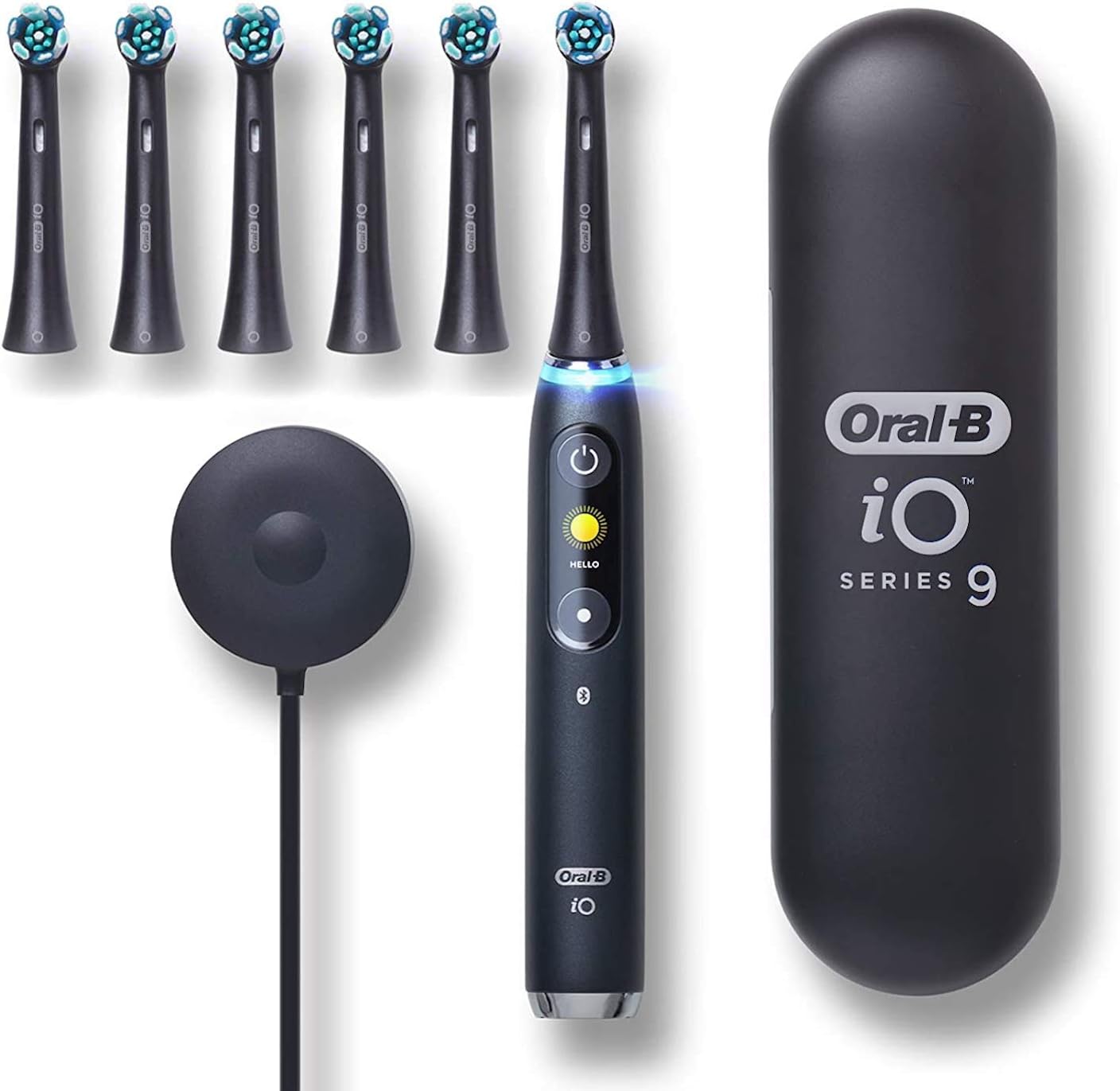
- The flagship: Oral-B iO Series 9, $299. Every feature Oral-B makes. See "what I'd skip."
Choose by what you actually need
| Your situation | Buy | Why |
|---|---|---|
| You just want the right brush | Sonicare 4100, $49 | Pressure sensor + timer. The essentials, done. |
| You have braces | Oral-B iO Series 3, $80 | The small round head is the best bracket-cleaning tool |
| Sensitive teeth or gums | Sonicare 4100, $49 | The gentler motion is what sensitive owners prefer |
| You want the evidence-backed action | Oral-B (oscillating-rotating) | A modest edge in the research |
| Tightest budget | Sonicare 1100, $30 | But you give up the pressure sensor |
| You travel constantly | DiamondClean 9000, $219 | The charging travel case is genuinely excellent |
| Cheapest long-term running cost | Oral-B classic-head models | The heads, not the handle, are the real cost |
How they actually differ, in the hand
Oral-B uses a small round head that oscillates and rotates (the iO line adds a magnetic drive with micro-vibrations). You clean tooth by tooth, holding the head briefly against each surface. It feels active and mechanical, and it is noisier.
Sonicare uses an elongated head vibrating at high frequency. You brush the way you already brush, sweeping along the gum line, and let the bristle speed do the work. It feels gentler, and it's noticeably quieter, which is not a trivial point at 6am in a shared bathroom.
Most people form a clear preference within a week, and it's usually about feel rather than performance. The round head gives you a methodical, obvious sense of where you've been, which suits some people enormously. The sonic sweep asks you to change nothing about your habit, which suits others.
For braces, though, it isn't a preference. The compact round head is the better tool for getting around brackets, and that's the one case where I'd tell you the answer regardless of feel. More in the braces guide.
The head-cost trap: the handle is the razor
This is where the real money is, and it's the thing almost nobody prices before buying.
You are meant to replace the brush head roughly every three months, which is four heads a year, for as long as you own the handle. Over three years that is twelve heads, and the head price varies a great deal between models. Oral-B's classic heads are the least expensive mainstream heads you can buy. Oral-B's iO heads are considerably pricier.
So the sticker price can lie to you. An iO Series 3 at $80 with expensive iO heads can cost more across three years than a Sonicare 4100 at $49. Price the heads before you price the handle. Our replacement head cost guide does the arithmetic.
What I'd skip
- Skip the $299 flagship. The iO Series 9 is a lovely object, and almost everything above the $80 iO 3 is app coaching, extra modes, and polish. It does not clean your teeth meaningfully better than a $49 brush with a pressure sensor. Buy the sensor and put the other $250 towards a dental visit, which will do far more for your mouth than a fifth cleaning mode.
- Skip the brush without a pressure sensor if you can afford the $19 step up. This is the one feature I'd genuinely insist on.
- Skip "whitening" modes as a reason to buy. A brush removes surface stains. It does not change the intrinsic colour of your teeth, and no brushing mode is a whitening treatment.
- Skip worrying about the brand. Truly. The gap between Oral-B and Sonicare is small. The gap between brushing well twice a day and brushing badly once is enormous, and it is the only gap you control.
- Skip scrubbing. With a powered brush, you guide it. You do not push it. Let the bristles work.
The panel: two lenses I don't own
The mouth and the evidence are mine. What this costs over its life, and whether it survives your actual routine, aren't.
Eran Yorkovsky, Value & Longevity lens: "Every electric toothbrush is a razor-and-blades business, and the handle is the razor. Four heads a year, every year, is the real cost, and it can quietly exceed what you paid for the brush. Before you buy, look up the price of a four-pack of the exact head that fits the exact handle you're considering, and multiply by three years. That number, not the sticker, is what you're actually agreeing to. It's also why an $80 Oral-B iO can end up costing more than a $49 Sonicare."
Michal Zucker, Design & Fit lens: "The best toothbrush is the one that's still being used in month six, and that's a habit question, not a technology question. Two things quietly decide it. Noise, because a loud brush at 6am in a shared bathroom is a brush that gets resented, and Sonicare is the quieter of the two. And charging, because a brush that needs its base every few days ends up abandoned on a trip. If you travel often, the DiamondClean's case is the feature you'll actually use, and every fancy cleaning mode is one you won't."
How we picked
No lab, no theater. Here's the process, so you can weigh it.
- Started from the clinical evidence, including Cochrane reviews of powered versus manual brushing and of oscillating-rotating versus sonic action, and reported the size of the effect honestly rather than the headline.
- Weighted the features that prevent harm (pressure sensor, timer) above the features that market well (modes, apps, whitening claims).
- Priced the heads, not just the handle, across a realistic three-year ownership.
- Graded on PickGrade's three lenses: Value & Longevity, Design & Fit, and Health & Environment.
- We don't fake hands-on testing. PickGrade doesn't run its own lab and never pretends to. My job is to read the research carefully and tell you what it does and doesn't support.
And one thing no comparison page can do: your dentist or hygienist can look in your actual mouth and see whether you're brushing too hard, missing a spot, or in fact doing fine. That's worth more than any of this. Ask them.
Last updated: July 2026.
Still choosing?
- Take the electric toothbrush quiz
- Best for sensitive teeth · best for braces · replacement head costs
- Oral-B iO 3 vs Sonicare 4100: the mid-range fork
- Sonicare 1100 vs 4100: is the sensor worth $19? · Oral-B iO 3 vs iO 9
- Product pages: Sonicare 4100 · Oral-B iO Series 3 · Sonicare 1100 · DiamondClean 9000
- See all electric toothbrushes