Buying guide
Best Electric Toothbrush for Braces
Reviewed by
Michal Zucker · Fitness, Movement & Wellbeing Editor
Braces make brushing harder exactly when it matters most — plaque left around brackets turns into permanent white spots. Here's why a small round head and a pressure sensor are the features that count, and which brushes deliver them.
 Take the toothbrush quiz →
What braces change about brushing
Brackets and wires create dozens of new plaque traps, and the consequences of missing them — white spot lesions and gum inflammation — show up exactly when the braces come off. An electric toothbrush helps for two reasons: the timer makes you brush long enough (orthodontic patients need more than two minutes, not less), and the right head shape can clean above and below each bracket in a way a flat manual brush struggles to.
What to look for
- A small round head. This is why oscillating brushes are the default braces recommendation: a compact round head can be angled at the gum line above the bracket, then below it, one tooth at a time. Wide sonic heads can ride on the brackets instead of the tooth.
- A pressure sensor. Brackets tempt people to scrub. A sensor protects both your gums and the brackets' bonding.
- Durable, affordable replacement heads. Brackets chew through bristles faster — expect to replace heads closer to every 8–10 weeks. Our replacement heads cost guide compares the ongoing math.
Our picks for braces
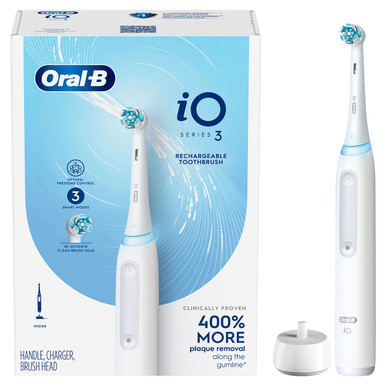
Best for braces: Oral-B iO Series 3. The small iO round head is the best bracket tool in our lineup, the magnetic drive feels smooth rather than rattly against orthodontic hardware, and the pressure-sensor light is easy to see. Full reasoning is in the review.
Premium option: Oral-B iO Series 9. Same head shape and drive with app coaching that maps coverage — genuinely useful when brackets make it hard to feel whether you've cleaned a zone.
If you strongly prefer sonic: Philips Sonicare 4100 with a compact or sensitive head still beats any manual brush, and many orthodontists are happy with either style as long as technique and time are right. The Oral-B vs Sonicare comparison breaks down the head-shape trade-off in detail.
Don't forget the spaces the brush can't reach
No electric toothbrush replaces interdental cleaning with braces. Interdental brushes, floss threaders, or a water flosser handle under the wire; your toothbrush handles everything else. Ask your orthodontist which combination they want you using — and take the electric toothbrush quiz to match the brush side of that equation to your budget.
Still choosing?
- See all Electric Toothbrushes
- Best Electric Toothbrush for Sensitive Teeth and Gums
- Philips Sonicare 4100 Review: The Rational Default
- Oral-B iO Series 9 vs Sonicare DiamondClean 9000
- Oral-B iO Series 3
- Philips Sonicare 1100
- Oral-B Kids Electric Toothbrush
Our electric toothbrush picks
- Oral-B iO Series 9
- Philips Sonicare 4100
- Philips Sonicare DiamondClean 9000
- Quip Rechargeable Electric Toothbrush
Still choosing?
Frequently asked
Can I use an electric toothbrush with braces?
Yes. Electric brushes are safe with braces and the timer plus head shape typically improve cleaning around brackets. Use light pressure and replace heads more often, since brackets wear bristles faster.
Is oscillating or sonic better for braces?
Both work, but small round oscillating heads are easier to angle above and below brackets, which is why they are the common orthodontic recommendation. A sonic brush with a compact head and good technique is also fine.
How often should I replace brush heads with braces?
Plan on every 8–10 weeks instead of the usual 12. Brackets fray bristles faster, and frayed bristles clean poorly exactly where braces need the most help.
Does an electric toothbrush replace flossing with braces?
No. You still need interdental brushes, floss threaders, or a water flosser to clean under the archwire. The toothbrush covers tooth surfaces and the gum line.